
Enjoy Happy Trails, the free monthly newsletter from Hiking For Her
Receive a free resource: "Hiking Layering System Explained"
Back Injury Prevention
For Hikers:
Sore Back As A Warning
By Diane Spicer
Back injury prevention for hikers involves:
- good body mechanics,
- a well designed and properly fitted backpack, and
- strong back muscles.
As you can see, it's a combination of what you can purchase, and what you provide for your back through commitment to be your strongest, best hiking self.
Back pain after a hike is a horrible souvenir to take away from trail time.
But it's a wake up call you should never ignore.
So it just makes sense to go down the path of back injury prevention for hikers.
Let's tackle the purchasing angle first.
The right backpack is key to
back injury prevention for hikers
Back injury prevention for hikers through the lens of your purchasing power boils down to this advice:
- don't wear just any old pack.
A flimsy day pack, cast off by your kids or found at a rummage sale, is not the way to go.
Or, at least not after more than the first few easy hikes you do.
- Your back muscles won't be shy about giving you feedback!
- A sore back after a hike may be an opinion from your muscles about that "bargain" backpack.
A hand-me-down or second hand store purchase may save money in the short run, but back pain costs you time and money down the road - or down the trail.
It may even discourage you from ever hiking again!
Just say no to an old used pack.
Why?
Because to be a strong hiker, you need a pack that gives you:
- lumbar support to transfer weight appropriately to your thickest vertebrae;
- a snug padded hip belt so you don't literally wear away your skin or create sore spots on your pelvis;
- a chest (pectoral or sternum) strap to transfer some weight off your back, and
- a proper ventilation system to allow sweat evaporation in the interest of keeping your body temperature within normal ranges (especially important if you're a menopausal hiker).
I'm not pushing you to buy a high-end pack with too many bells and whistles. (Think I'm kidding? There are packs with a whistle right on the straps, and a place to attach bear bells!)
In fact I'd discourage you from paying a lot of money for bells & whistles you will never use, like an ice axe loop - not to mention the trendiest new colors.
- Did you know packs have hot new colors, just like runway models flaunting the latest clothing colors?
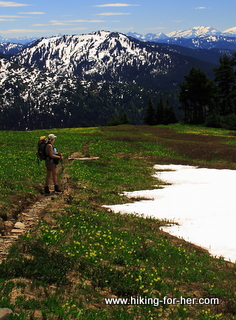 Back injury prevention for hikers: start with a great pack.
Resources for you
To find out how to locate the pack of your dreams along with other hiking gear, go here.
Hiking For Her's backpacking buying guide here
A review of a trusted backpack here
Still hesitant to invest
in your well being?
Not ready to commit to purchasing the best dayhike pack yet?
Here are some ideas for scoping out packs without being stuck with a less than ideal purchase:
- rent packs from outdoor stores like REI,
- lurk
in the pack section of your favorite outdoor gear store & watch
what's being recommended and tried on by people of your body size and
gender,
- borrow a friend's backpack,
- stop women on the trail and ask how they like their packs.
...in short, become a pack hound.
(Which is not to suggest that you are a beagle.)
If the pack fits,
should you wear it?
How to determine if the pack you're interested in purchasing fits you?
Long story short:
You need to try on every backpack in front of a full length mirror and decide:
- Does it loom over you?
- Does it hug you like a glove?
- Or does it feel stiff and bulky?
AND you need to walk around with some weight in the pack, carried down low and representative of the amount you would carry on a trail.
It's one of the best pieces of "back injury prevention for hikers" advice I can give you!
Where to shop?
Much as I love the convenience and competitive pricing of Internet shopping, I would caution you against purchasing a pack without trying on several first.
Yes, I know that you can return it in the mail if it doesn't fit, but why waste time (not to mention environmental resources) until you're really clear about what you need?
Find a nearby store that seems friendly and cozy up to a salesperson who is knowledgeable about hiking. Any old big box store with a limited selection won't do - you need an experienced hiker to sell you a pack!
Have this person suggest packs after explaining what type of hiking you'll be using it for, and then be meticulous in adjusting each one until you can decide if it's a potential candidate.
After spending your time and theirs wisely, seriously consider purchasing the pack from that salesperson, unless the prices are seriously inflated (which you would know, by doing some comparison shopping online before entering the store. Go here to do this.)
It should not shock you to hear that I put as much thought into purchasing hiking gear as I do with purchasing a car, and for much the same reason:
- I want hassle-free reliable performance and durability, each and every time.
Or you could use the Cinderella analogy!
- Find your princely pack because nothing else will ever satisfy you.
Back injury prevention for hikers: try these timely strategies
I hope I've convinced you about investing time in finding THE pack in order to avoid back pain after a hike.
Now let's look at back injury prevention strategies for hikers that cost time, rather than money.
Proper ergonomics
Body mechanics are a big factor in preventing back pain.
Answer these questions about your body mechanics in the privacy of your own mind:
- Do you ever catch a glimpse of yourself in a mirror and notice that you're hunched or stooped?
- When you see photos of yourself, are you holding your neck at a funny angle?
- Do you wake up stiff or sore in the morning because you've slept on your back or stomach?
- Do you always sit with your legs crossed at the knee, and usually one leg always over the other?
- When you're driving or hiking, do you crane your neck forward in an effort to see? (Has your vision been checked lately?)
- Do you get a literal "pain in the neck" during the day?
These are all examples of improper body mechanics which, over time, can give you back pain and loss of mobility on the trail.
The bad news
So the bad news is that back injury prevention for hikers is a full time job, in terms of establishing good habits (or breaking bad ones first).
And it's no surprise that if you add a heavy field guide, a camera bag, and some heavy water bottles into the mix, your already-weakened back will begin to talk to you:
- spasms,
- soreness,
- tingling sensations,
- shooting pains,
- loss of flexibility, and
- worse (herniated discs, pinched nerves...big OUCH, and expensive).
Hiking For Her tips on how to pack a backpack might be useful here :)
We're not done yet!
And it's not just wearing the pack that you must pay attention to!
Here are more questions in your back injury prevention self assessment:
- How do you pick up your pack? (One hand, both, from a crouched position or straight legged... pay attention next time!)
- How do you swing it over your shoulder? Which shoulder goes first?
- Are you sitting or standing when you put on your pack?
- When you take a rest break, do you shrug off the pack and let it drop off your back, tugging your head backwards?
- Do you adjust the straps continually throughout the hike, or just at the beginning? Or not at all?
- Do you ignore feedback like pinching, soreness, pain, rubbing or hot spots?
All of these motions can stress the multitude of joints in your backbone, not to mention tick off your muscles.
You probably can guess that it's important to use good body mechanics every day, but especially when you're lifting and wearing your filled backpack.
A little scenario for you
Play out this little scenario to gather more information about your tendency to ignore/practice good hiking ergonomics:
imagine yourself, standing up from a nice comfy moss covered log and reaching for your backpack.
- Do you let your dominant arm drag it over to you without bending your back (thereby stressing your shoulder AND your spine)?
- Do you lift the pack without bending your knees, and sort of throw it onto your back?
- Do you pivot as you hoist up the pack?
These are negative examples of hiking biomechanics - don't continue to do them if you truly believe in back injury prevention for hikers!
OK, I can hear you thinking: "So what is the proper way to put on a pack?"
It depends on the size and weight of the pack, to some extent.
It also depends upon your upper body strength.
- Here's some good advice
A little bit more
And here's my 2 cents worth of advice on back injury prevention for hikers:
- If possible, when removing a heavy pack try to ease the pack onto a rock or tree stump so you don't have to bend over to get it back on
- Bend your knees! Let the strength of your thigh muscles along with your back muscles work together to accomplish the task.
- Always use and adjust the chest and hip straps, because they help distribute weight into the bones of your pelvis, away from your lower back muscles.
Upper body strength
is key!
Vow to work on developing upper body strength, so you can
let your arms and chest control the weight of the pack until it is
properly seated on your back.
Here's how I started:
Crown Sporting Goods Sprint: Set of 3 Pairs of Neoprene Body Sculpting Hand Weights
Yoga for hikers can be an excellent way to build upper body strength.
Some of the poses are known to stabilize and strengthen the shoulder girdle.
And older hikers will welcome the chance for increased flexibility.
Overpacking
is asking for trouble
And finally, reconsider every item in that pack - is the weight justified by absolute necessity?
Or are you over-packing?
If you can't hoist the pack up by a few fingers on one hand, it's too heavy!
Drop some weight.
Or start lifting weights! (see above)
The bottom line for back injury prevention for hikers:
Get strong.
Stay strong.
While we're on the topic of gaining strength, let's shift our attention to strong back muscles.
Most of us sit way too much every day, and have lost flexibility over the years.
You already know where I'm going with this.
I know, I know: daily exercise and back stretches are a real pain.
But so is chronic back pain! (literally)
A strong vertebral column is a fantastic gift to give yourself, particularly as you age.
So how to achieve it?
This depends upon your personality.
Are you a social person?
- Maybe an exercise class, meeting a few times a week, would be the way to go. There are classes specifically targeting your core muscles - watch for ads at community centers, fitness centers, and universities.
- Water aerobics is a good choice if you are already experiencing knee or back pain, as it reduces the effect of gravity on your joints and provides resistance to strengthen your muscles.
For those who have a more introverted nature, a home fitness routine is more appealing (ask me how I know).
- It's impossible to cover all of the choices you have at your disposal, but the Internet can provide you with many options, from jumping around to music in your living room (Zumba, anyone?), to a treadmill, to Pilates, to yoga.
A suggestion for a
daily life change
Here's something I do to enhance my posture and spinal strength during my long hours sitting at a computer:
I perch on a balance ball chair.
- This forces me to trigger all of the little spinal muscles, teaching them to keep my posture long and lean.
I love it so much I can't go back to my "regular" office chair any more!
And I notice that my posture on the trail is much taller - I don't slouch into my pack and I don't crane my neck in front of my body.
Bonus:
I use the balance bar to do some stretching every day.
My spinal column flexibility is NOT what it used to be. But this gives me a gentle way to remind my body that my back is for strength AND flexibility.

More thoughts on back injury prevention for hikers
Here's another thought:
If you visit a massage or physical therapist regularly, ask him/her about back strength & flexibility exercises.
These therapists deal with muscles on a regular basis, and will be familiar with the various types of back pain you might be experiencing - even to the point of knowing exactly which muscle is responsible.
If they give you exercises and stretches, commit to doing them every day.
And speaking of the spinal column, it's held together by more than just muscles: connective tissue fibers called ligaments connect the bones, while other connective tissue called fascia acts as packing and wrapping material.
And we haven't even mentioned the hard working blood and nerve supplies! They can be impinged upon, and cause trouble, too.
Regular bodywork helps to normalize the functions of these fibers and essential body routes.
- Consider it a vital component in your plan for back injury prevention for hikers.
Are you your own
best friend?
So after reading all of this information about back injury prevention for hikers, ask yourself:
Are you your own best friend,
or your back's worst enemy?
A strong healthy back is a precious resource for any hiker, and that's why back injury prevention for hikers is a hot topic for those who want to keep burning up the trails!
Invest in the time and gear necessary to preserve your resource, and you'll be hiking with ease and grace for decades to come.
Once you get on the back injury prevention for hikers train, there will be no more sore backs, back pain or stiffness for you!
Home page > Injury Prevention >
Back Injury Prevention for Hikers

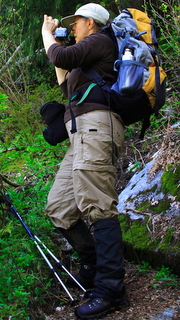
Diane started hiking in 1971. She started Hiking For Her in 2008 as a resource to encourage every woman to take a hike. Please enjoy these expert hiking tips as you explore what hiking offers in any weather, season or location.
Meet Hiking For Her's Diane
TODAY'S BEST OUTDOOR GEAR DEALS
REI Co-op Members save an extra 25% on REI Outlet fitness clothing & gear 4/12 thru 4/15.
Example: Hydro Flask bottle with cap, marked down from $49.95 to $26.73.
Use code OUTFIT24.
See ALL the great deals on the Hiking For Her Best Current Deals page!
POPULAR POSTS


Diane Spicer founded the Hiking For Her community in 2008 to encourage female hikers, those who wanted to begin hiking as well as those who were in love with this fantastic sport already.
On this website she shares expert hiking tips and recommendations, gear reviews and photos from her outdoor adventures to welcome everyone to learn the necessary skills for comfort and safety on a hike.
This reader supported website does not use sponsored or promoted content. There are no ads or paid link placements. Everything you read is based on decades of personal hiking experience in many different locations.
All rights reserved.
Photo credits: All photos on this website were taken by David Midkiff or Diane Spicer except where noted.
Disclosures
Privacy
Copyright
Media
As an Amazon Associate, Hiking For Her earns from qualifying purchases.
When you buy through our links to trusted outdoor gear affiliates, we may earn a commission while you pay nothing extra.