
Enjoy Happy Trails, the free monthly newsletter from Hiking For Her
Receive a free resource: "Hiking Layering System Explained"
Foraging for Food:
A Fun Hiking Hobby
By Diane Spicer
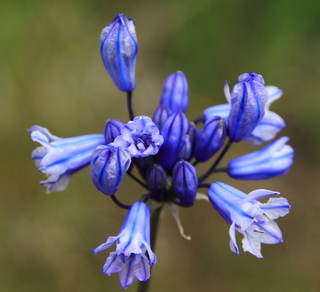 Poisonous or not? Foraging for food must be done with reliable resources and guidance.
Foraging for food is fun only when you don't HAVE to do it.
- You're better off with your reliable hiking food, packed according to your individual taste preferences and activity level.
For me, food foraging for wild edibles on a hike is a hobby.
- But in the back of my mind, I know that this type of knowledge may buy me some time if I'm stuck in the back country.
So I try to learn a few new wild edibles each hiking season, to add to my repertoire.
Never tried food foraging before? Start with something easy (and delicious)!
Foraging for food:
berries, not mushrooms
Full disclosure: I'm a mushroom wimp, meaning that I don't tend to fool around with sampling Mother Nature's bounty.
She has decided which are edible, which are not, and until I take a class on mushroom identification, I'm sticking with visual admiration, not gustatory admiration, of the ones I see along the trail.
However, berries are a favorite while foraging for food.
In the Pacific Northwest (my stomping grounds), we have
- salmon berries,
- thimble berries
- blackberries
- huckleberries
- blueberries
- raspberries
to name just a few.
Some of my favorite hikes are categorized under "berry hikes" in the fall.
What could be better than throwing off the pack, plopping down in the berry patch, and eating my way back to the trail?
After all, that's what the bears do. Much tastier than tree bark, don't you agree?
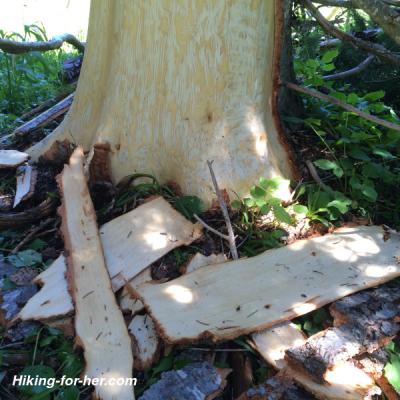 Strips of tree bark freshly shredded by a black bear in Mt. Rainier National Park
Berry caution!
A few notes of caution:
When you are first learning to identify berries, avoid white or green berries, as they are mostly poisonous.
- Red berries have a fifty-fifty chance of being edible. Ingest with caution.
- Most blue berries are going to be okay.
In a survival situation, eat only a few and see if you react (watch for tingly tongue and shortness of breath) within 30 - 60 minutes.
A general food foraging resource
for you
Here's a free online resource from the U.S. Army on edible and medicinal plants.
- Not as handy as a "real" field guide in your pack, but useful for learning your plants!
Field guides
are the way to go
I've made sure that I know my berries, using a few beloved field guides.
These books and electronic resources have also helped me out with identifying poisonous plants to avoid.
Here's an example:
I've made really sure that I can pick out water hemlock (also known as spotted cowbane).
Why? Because it carries the most deadly toxin in the Western hemisphere, with no antidote.
- Only a tiny bit on your tongue is deadly.
- If you know your Western history, you'll recall how it was used for that suicidal purpose.
The problem with spotting water hemlock?
It looks a lot like common, completely innocuous edible and medicinal plants that share its habitat.
Luckily, it stinks!
- Which explains one of its other names: poison stinkweed
Take home message for hikers
If nothing else, learn to identify the top 5 poisonous plants in your area.
For me, that includes:
- water hemlock, mentioned above
- poison ivy
- poison oak
- deadly nightshade (to be fair, there are a lot of nightshades, and only one is called "death's herb", but I avoid all of them)
- foxglove (highly toxic seeds)
Avoiding the nasty plants will keep you safe while you enjoy learning the hundreds of medicinal and edible plants in your area.
Soon you'll be on a first name basis with the ones that can pull you through a survival situation.
These are the books I use
in the Pacific NW
Mother Nature is the original source for so many of our medicines, including aspirin, digitalis, and antibiotics.
I find it fascinating to identify medicinal plants in their natural settings.
And these are the botany field guides and wildcrafting books I have on my bookshelf, and carry in my backpack:
Medicinal Plants of the Pacific West, by Michael Moore
Field Guide to the Cascades and Olympics, by Rob Sandelin
Mountain Plants of the Pacific Northwest: A Field Guide to Washington, Western British Columbia, and Southeastern Alaska, by Ronald J. Taylor
Edible and Medicinal Plants of the West by Gregory L. Tilford
Midwest resources
for newbie food foragers
Edible and Medicinal Wild Plants of the Midwest by Matthew Alfs
Medicinal Plants of North America by Jim Meuninck
Go forth and forage
You're all set with these solid resources for plant identification.
Be sure to set aside some time on your next spring or summer hike to get to know your plant neighbors.
They're quiet, mostly friendly, and fascinating.
Home page > Best Hiking Tips >
Foraging For Food
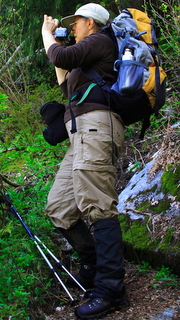
Diane started hiking in 1971. She started Hiking For Her in 2008 as a resource to encourage every woman to take a hike. Please enjoy these expert hiking tips as you explore what hiking offers in any weather, season or location.
Meet Hiking For Her's Diane
TODAY'S BEST OUTDOOR GEAR DEALS
REI Co-op Members save an extra 25% on REI Outlet fitness clothing & gear 4/12 thru 4/15.
Example: Hydro Flask bottle with cap, marked down from $49.95 to $26.73.
Use code OUTFIT24.
See ALL the great deals on the Hiking For Her Best Current Deals page!
POPULAR POSTS

Diane Spicer founded the Hiking For Her community in 2008 to encourage female hikers, those who wanted to begin hiking as well as those who were in love with this fantastic sport already.
On this website she shares expert hiking tips and recommendations, gear reviews and photos from her outdoor adventures to welcome everyone to learn the necessary skills for comfort and safety on a hike.
This reader supported website does not use sponsored or promoted content. There are no ads or paid link placements. Everything you read is based on decades of personal hiking experience in many different locations.
All rights reserved.
Photo credits: All photos on this website were taken by David Midkiff or Diane Spicer except where noted.
Disclosures
Privacy
Copyright
Media
As an Amazon Associate, Hiking For Her earns from qualifying purchases.
When you buy through our links to trusted outdoor gear affiliates, we may earn a commission while you pay nothing extra.