
Enjoy Happy Trails, the free monthly newsletter from Hiking For Her
Receive a free resource: "Hiking Layering System Explained"
Hiking and Osteoarthritis:
Strategies For Hikers
By Diane Spicer
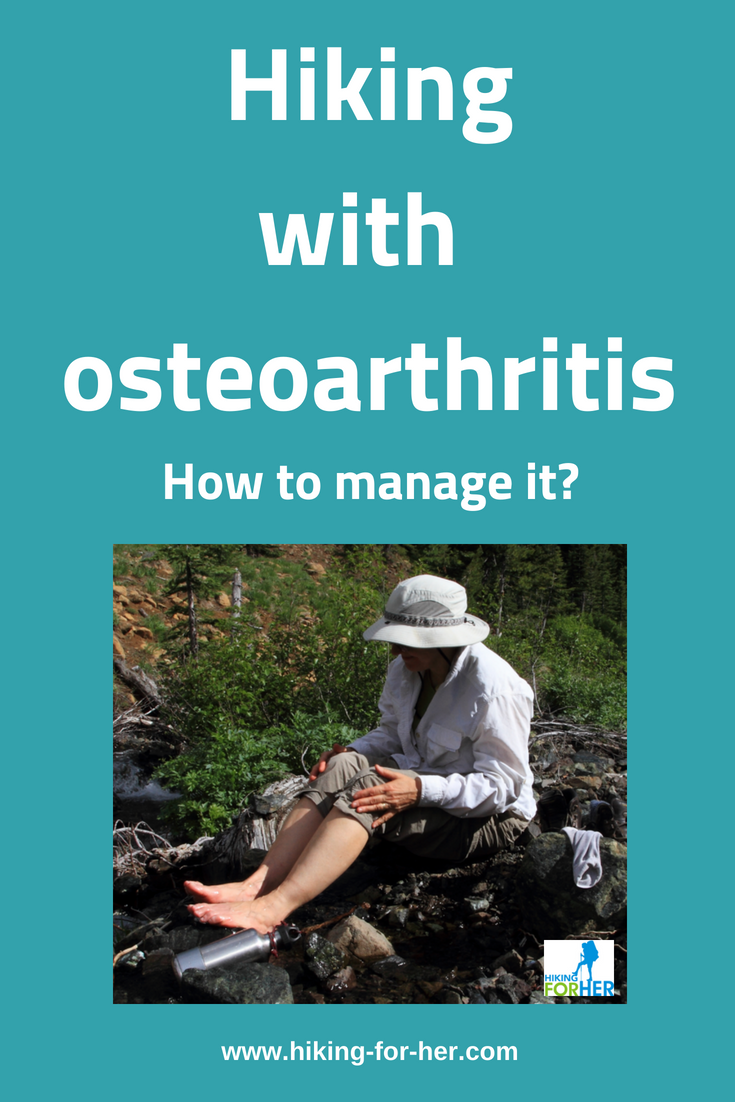
Hiking and osteoarthritis: not a subject to ignore.
This type of arthritis is called "wear and tear", so it can be associated with older hikers.
If you're a twenty or thirty-something hiker, osteoarthritis might seem like a topic you can safely put off until "later".
- The reality of a painful hike due to this type of arthritis could appear to be decades away.
But think again about the possibility of hiking osteoarthritis.
Here's a question to ask yourself.
Can knee injuries
lead to osteoarthritis?
A recent review on the topic of hiking and osteoarthritis caught my eye because it connected knee injuries with developing osteoarthritis.
Ever injure your knee or ankle? Hmmm...
If you want to read it for yourself, the study was published in the journal Arthritis Research and Therapy: Prevention of injury-related knee osteoarthritis, 2010, 12:215 edition.
The researchers, Charles R. Ratzlaff and Matthew H. Liang, are employed by the School of Population & Public Health in Vancouver, British Columbia.
The authors declare no competing interests, meaning that they're not taking money from companies related to the diagnosis and treatment of arthritis.
Their research was funded by the Canadian Institutes of Health Research, but also by the Molson Foundation and the Michael Smith Foundation for Health Research.
I'll recap it for you below.
Hiking and osteoarthritis:
What's the connection?
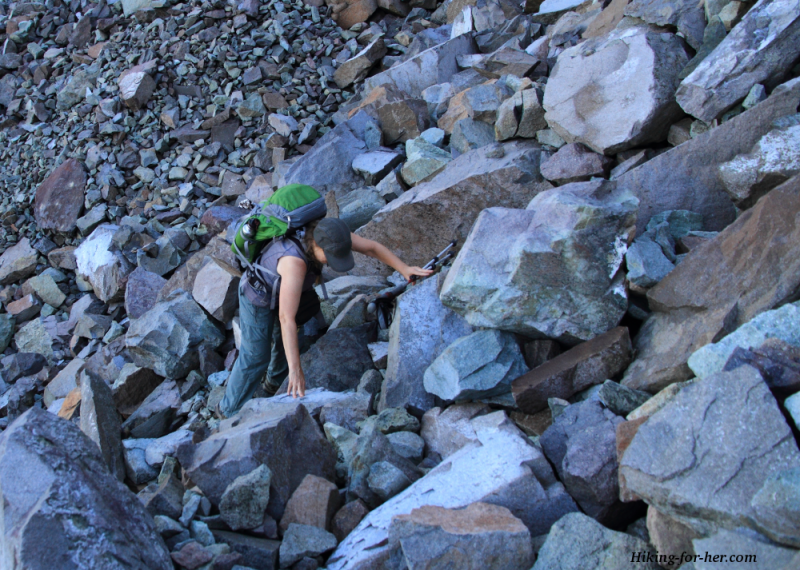 Hiking and osteoarthritis might make you feel like you're climbing uphill through a boulder field, even when you're not.
First, let's define our terms more specifically.
Osteoarthritis refers to "wear-and-tear" and inflammation of the synovial (freely movable) joints of the body ("osteo" for bones, "arth" referring to joint, "itis" for inflammation).
Ouch, right?
The older your body gets, the more likely it is that you'll have this type of inflammation.
As a hiker, you bear weight by carrying a pack, plus put your knee cartilage through vigorous usage, on every hike, season after season.
This may result in overuse problems.
Weigh this carefully
Body weight comes into the equation as well.
Carrying a few extra pounds in your pack, added to a few extra pounds on your skeletal frame (especially after a winter of inactivity), spells more work for your knee joints on the trail.
And if you tackle steep trails, even more work!
This increases the potential for knee damage, which could lead to inflamed knee joints over time.
Trail tips:
Carry the lightest pack you can.
Be ruthless about your checklist, and toss out anything that does not serve you well on the trail.
More tips for lightening your load here.
One more factor in the osteoarthritis picture
The article mentioned above brings in one more factor: previous injuries.
In technical terms:
"Joint injury will increase a person's risk of developing knee osteoarthritis.
For example, research shows that 50% of anterior cruciate ligament (ACL) injuries or meniscal tears will develop knee osteoarthritis."
Ligaments hold bone to bone, and with a complicated and mobile joint like the knee, they seem a bit "under engineered" to me!
What do I mean?
Knees can go out of alignment, just as tires on a car do. This creates areas of "wear" on the cartilage (again, like tire tread fading with usage).
- If the meniscus is injured, load bearing and shock absorption will decrease while joint stability also decreases.
- If ligaments and the joint capsule are injured, pressure distribution across the cartilage will change, placing the precious, hard to regenerate cartilage at risk.
Add in one more component: muscular reaction to knee injury.
If your knee hurts, you're going to walk differently, and begin to lose strength in the muscles of that thigh and leg.
You'll also overload the other knee!
If the pain is chronic, the relationship between the nerves and the muscles will change, and put the injured knee joint at risk for increased loads and shear forces when a person is caught off guard - a lurch forward on a rocky trail, for example.
The authors of this research article counsel prevention of knee injury, especially for young athletes.
Not so fun facts for female hikers
Our pelvic anatomy works against us here.
Compared with a male pelvis, a female pelvis is aligned in a wider stance.
This puts more pressure on our hip and knee joints.
More pressure means more wear and tear.
We also go through menopause, when hormones levels fluctuate and drop off dramatically. No one seems to know if that contributes to osteoarthritis, but studies are ongoing.
So hikers, heads up
on being proactive!
To
avoid osteoarthritis from side lining your hiking career, keep your
mobile, weight bearing knee joints protected and injury free.
To keep the knee cap (patella) tracking properly on a long hike, hikers of any age might want to try a flexible support like this one.
Regular non-weight bearing exercise for cross training your joints might help, too: swimming, stationary biking, yoga.
Trekking poles are important for preventing knee pain, and if you disagree, please read my ideas before you discard the idea entirely.
How does osteoarthritis show up
in a hiker's body?
It's not shy, that's for sure.
You might begin to notice a few new, somewhat alarming sensations and sounds in your body as an early warning system.
Your knee might make crunching sounds, or your neck when you roll it from side to side could pop or crunch.
- Official word: crepitus.
- It "creeps" us out because it indicates bone-on-bone motion. The padding from cartilage is diminishing and not being replaced.
You might feel stiff when you get up out of a chair that has kept you immobile for long periods of time. This short term stiffness goes away once you move around a bit.
As time goes on, joint pain shows up to get your attention.
- It's important to rule out other problems, so get to your doctor ASAP for an evaluation of any painful joint. An x-ray will catch any cartilage loss, bony overgrowth or other signs of osteoarthritis.
Hiking with osteoarthritis -
a few tips to try
If you are hiking with diagnosed osteoarthritis, and/or have already had a few knee injuries, now what?
Search for your modifiable risk factors, and change them.
Here's an example:
- Avoidance of weight gain will protect the knee from further damage.
So
will a conscious effort to insert daily load bearing activities into
your daily schedule: moderate exercise such as walking, stationary biking, or swimming to protect your knees.
Why bother?
Strength training has been noted as an important preventative measure by sports medicine physicians, because it stabilizes the joints to avoid soft tissue injury.
- As a hiker, strengthening your quads (quadriceps - the big muscle group on the front of the thigh) will protect your knee joints.
Wear only the best trail footwear.
Eat well to recover quickly from the micro-traumas of hiking.
Keep hydrated on the trail. Your connective tissues need water!
Baby your knees with these tips on hiking with arthritic knees.
Postcards begging for self care
in arthritic hikers
When you receive lovely little postcards from your joints (twinges, pain, limitations on range of motion, for example), don't ignore them!
- Implement some hiking self-care.
If you already have diagnosed osteoarthritis with predictable knee pain, functionality of all of the knee ligaments (not just the ACL) might be compromised.
It might be time for a knee brace.
I know, I know: They are ugly.
They are also supportive for all 4 knee ligaments, lightweight, breathable, ventilated, adjustable and washable.
So suck it up and put one on, or hang up your boots.
Your call.
Also consider a good pair of cushioning, stabilizing hiking insoles.
(Tough love. You're welcome.)
Another idea for hiking
and osteoarthritis management
Carry reusable gel packs if you know you're going to be hiking with access to cold running water or snow pack.
Alternatively, throw these in the freezer and bag them up just before setting off for the trail head.
- At lunch time, apply the packs to your knees (and other hot spots) to soothe inflammation and cool things down.
Don't forget to stash one in a cooler in your car, waiting for you when you finish your hike.
Use a sensible approach to
hiking and osteoarthritis
Another thing you can do to manage the duo of hiking and osteoarthritis with a good attitude is to modify the trails you tackle.
- I've already eliminated a few steep hikes from my hiking repertoire, and when I get the itch to re-visit them, I pull out my photos and reminisce!!
To help you find appropriate hikes, use the hiking guide book series entitled "Creaky Knees".
- You can get started right here.
Hiking and osteoarthritis:
keep going!
Joint wear and tear is a fact of life for a hiker's body.
- Even more so for an active hiker taking thousands of steps with a lot of elevation gain and loss on each hike.
But by taking precautions and avoiding injury, your knees will be able to get you into the back country for a long, long time!
If you already have an annoying level of pain, talk with your health care provider about using over the counter (OTC) arthritis strength pain relief.
Hiking and osteoarthritis can co-exist. I know that for a fact!
And if I spot you on a trail in your knee brace, I'll be sure to stop and say hi as we compare brands ;)
- You'll hear me coming - creaky knees will give me away!
Home page > Best Hiking Tips >
Hiking and Osteoarthritis

Diane started hiking in 1971. She started Hiking For Her in 2008 as a resource to encourage every woman to take a hike. Please enjoy these expert hiking tips as you explore what hiking offers in any weather, season or location.
Meet Hiking For Her's Diane
TODAY'S BEST OUTDOOR GEAR DEALS
REI Co-op Members save an extra 25% on REI Outlet fitness clothing & gear 4/12 thru 4/15.
Example: Hydro Flask bottle with cap, marked down from $49.95 to $26.73.
Use code OUTFIT24.
See ALL the great deals on the Hiking For Her Best Current Deals page!
POPULAR POSTS


Diane Spicer founded the Hiking For Her community in 2008 to encourage female hikers, those who wanted to begin hiking as well as those who were in love with this fantastic sport already.
On this website she shares expert hiking tips and recommendations, gear reviews and photos from her outdoor adventures to welcome everyone to learn the necessary skills for comfort and safety on a hike.
This reader supported website does not use sponsored or promoted content. There are no ads or paid link placements. Everything you read is based on decades of personal hiking experience in many different locations.
All rights reserved.
Photo credits: All photos on this website were taken by David Midkiff or Diane Spicer except where noted.
Disclosures
Privacy
Copyright
Media
As an Amazon Associate, Hiking For Her earns from qualifying purchases.
When you buy through our links to trusted outdoor gear affiliates, we may earn a commission while you pay nothing extra.