
Enjoy Happy Trails, the free monthly newsletter from Hiking For Her
Receive a free resource: "Hiking Layering System Explained"
Hiking Pace:
Mix It Up A Little
For Best Trail Results
By Diane Spicer
Some hikers are what I call "fast starters" in terms of hiking pace.
They practically run up the trail, before their muscles have had a chance to get warmed up.
They are either oblivious to their cold muscles, or determined to get a "head start". Whatever that means.
Unless they actually ARE trail runners!
Regardless, their muscles can't be happy with a fast pace right out of the gate.
And speed might not equate to distance if muscle cramps and fatigue appear early in a hike.
The flip side of trail life
Other people are "slow starters".
They hike for ten minutes, then stop to make multiple adjustments to gear, or look for a snack, or consult the map, or just want to talk.
There's nothing wrong with making adjustments and being attuned to comfort level, in fact I encourage it.
But I'm left wondering how muscles will ever get warmed up and into the proper rhythm for the hike at such an inconsistent hiking pace.
So what is a
normal hiking speed?
What a great question!
And there's no right answer to give you here.
If we were on a hiking trail together, I could demonstrate ways to attack elevation gain or loss, trail obstacles, and other pacing issues.
If I could take a peek at your hiking route on a map, I could give you a tailored answer, along the lines of an optimal hiking speed for your hike.
But that's not an option.
So let's ask another question instead.
What is an average hiking speed?
The average hiking speed of a hiker can be estimated using a formula named for the guy who put it together: Naismith.
He figured that 3 miles per hour of walking sounds reasonable for a maintained trail (no rocks or roots, no dicey footing, etc.).
So if you plan to hike on fairly level terrain, in 3 hours you can conquer 9 miles, carrying a moderate amount of weight in your backpack. That's a lot!
However, if the trail isn't dead flat, you'll need to add more time per miles.
Your optimal hiking speed
Now let's dial in your own optimal hiking speed, knowing that your speed dictates how far you can travel per day.
In general, a conditioned hiker who knows where she is headed on a maintained, well signed trail can expect to cover between two and three miles per hour (3.2-4.8 km/hour).
- Stopping to figure out the route, or to adjust gear frequently, eats into your hiking pace.
Elevation and hiking pace
For each thousand feet of elevation gain, add about 50 minutes to your calculations.
[This number comes down a bit with pre-hike conditioning.]
Makes sense, right?
- Going uphill takes more effort, slows you down, and forces you to adopt a slower pace, thus extending the time it takes you to get to your destination.
And coming down off those high points?
- Allow for at least 20 - 25 extra minutes for a loss of a thousand feet.
You're not actually going to shred your knees by running down that steep trail bearing weight, are you?
- It might surprise you to hear that going downhill is harder than going uphill.
- Balance, stamina, knee strength - the trail demands a lot on a downhill stretch.
Using Naismith's formula
To harness the wisdom of Naismith's formula for your own hikes, pull out your topographic map and see when (if) you'll be hiking through steep terrain, both ascents and descents.
Then estimate how long it will take you to get to that alpine lake, windy ridge, or campsite.
Add in a fudge factor to cushion your estimate, because eyes on the ground are always better than a map. You won't know what you'll face until you see it.
And hey! If you don't have to use that cushion of time to arrive safely at your destination, you'll have some extra time to dink around.
Perfect pacing strategy!
Log your hikes to determine
your personal hiking pace
Log your mileage and time (speed) over one entire hiking season, and see how it varies.
- Knowing how much distance you've covered, divided by the amount of time it took you, gives you an average hiking speed for hikes you've already done.
Fight the urge to make yourself look good on paper. You want accurate data!
If you feel the need to geek out on calculations of hiking pace planning and adjustments, this guy will help you out.
Hiking pace tip
To avoid bitter disappointment and running out of daylight, don't rely upon the mileage stated on trail signs.
Some of the signs can be outdated, or may not be reliable due to trail re-routes or detours.
- Always double check your distances on your current map, and on your GPS unit.
Backcountry and remote hiking pace
If you're planning to explore off trail, your pacing will have to be readjusted constantly.
- It can take hours to work your way across a brushy slope.
- Maddening reality: one mile per hour is a good estimate for off trail hiking.
Remote hiking terrain will dictate when you can hit it hard, and when you will have to slow down for water crossings, or spend time to work your way around a talus pile or mud slide.
You might even have to turn around and attempt a different route.
It's not crazy to expect less than one mile per hour.
Tip:
Try to get on a high point to scope out any obstacles, like lingering snow cornices, debris flows not marked on a map, or stream re-routes due to natural disasters (flood, earthquake, erosion due to fire).
- Plus, throw in a heaping dose of caution: you're way out there, on your own, so don't push too hard and take unreasonable chances in order to achieve a set hiking speed.
- Slow and safe, that's the right attitude.
Many factors affect hiking pace,
but pay attention to your body
Ever have one of those days on the trail when your legs feel like cement?
Or your lungs are burning after just 5 minutes of uphill work?
I have learned to give in gracefully on those days and slow my pace to accommodate my aging body.
If I try to ignore the feedback signals and forge ahead at a too-fast pace, my body pays me back later by not wanting to reach the summit, or being cranky and sore the next day.
And I definitely want to avoid inflammation in my muscles and joints.
That's why I check in with myself and pay attention to how I'm feeling after about 30 minutes of hiking.
I use that data to adjust my hiking pace to my internal conditions, even when external conditions say I can go faster.
So here's the nugget of
hiking pace wisdom
If your body feels tired, sick, reluctant or drained of energy, re-think your hiking plan.
Adjust it, or sit down for some fuel (trail snacks) and hydration.
Or abandon your plan altogether. Head home and take care of yourself!
And on days when your legs feel great?
Smile a great big hiker smile!
Then pick up your pace until you are close to "hitting the wall", and back off slightly to maintain that pace.
Hitting the wall
You won't miss the signs and symptoms of this unpleasant event.
Hitting the wall can include:
- ragged, tortured breathing
- maybe a stitch in your side
- lots of sweat pouring down your back and neck
- feeling like you want to vomit
- burning thigh & leg muscles
Every fiber of your being will say STOP, or at least SLOW DOWN.
It's probably obvious, but let's mention it here anyway: Your level of conditioning is important for trail pace.
- A conditioned hike can avoid hitting the wall, or at least delay its onset, because her body is prepared to go hard for long periods of time.
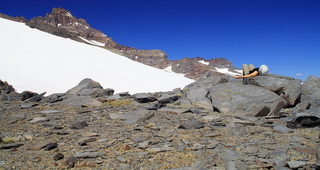 And sometimes you just gotta give in and become one with the rocks! Resting is a hiking pace, isn't it?
Many variables will dictate
your hiking pace
If you're hiking with a load on your back, your average day hike pace will need to be adjusted downward to accommodate the weight in your larger backpacking pack.
Another factor that can should affect your pace?
Trail conditions.
It's not possible to know ahead of time if there are downed tree limbs or deep ruts left by dirt bikes or horses on the trail (unless you were lucky enough to hear it through the grape vine or read a current trail report).
What if it rained the night before, leaving deep mud holes to negotiate? That will definitely slow you down.
As will hiking on unstable surfaces like pebbles, sand, or gravel.
There's also the possibility that a stretch of trail is closed or re-routed for maintenance or animal activity such as elk breeding season or grizzly sightings.
Life happens!
Again, I caution you to be philosophical about all of these possibilities.
If you have to go slower, so be it.
Of course, it will eat into your turn around time on a day hike, but perhaps you can make up the time higher up or farther along the trail.
It can also mess with your backpacking itinerary, when you have permits to camp at certain spots and not enough daylight left.
- Tip: Always keep a running tab on how much time remains until you reach your hiking objective (waterfall, lake, summit, camp site) so you don't get into a time bind.
- If you run out of daylight, be sure it's safe to hike via headlamp. You might have to abandon your original plan and go with Plan B.
Some folks set a timer and when it's turn around time, guess what they do?
They turn around!
Brilliant!
An important non-negotiable
pacing issue
And there's one big condition affecting your hiking pace which is non-negotiable: meeting a bear on the trail.
Don't even think twice.
Simply backtrack and allow the bear at least 30 minutes to clear out before venturing back for a peek.
You are in his/her living room, after all!
- Be extra cautious if you spot cubs. You know the stories about mama bear bad manners, and they're all true.
Here are some bear repellent strategies.
You can make up the time, turn around, or use the 30 minutes to plan another option.
What terrain is the trail
taking your through?
The contours of the terrain dictates pace, too.
In the Pacific Northwest, most day hikes to a viewpoint involve a big investment of time climbing uphill in order to gain a vista.
- A vertical gain of three or four thousand feet in several hours is all in a day's work.
- As is the mental agony of losing all of that hard work within an hour on the descent; ya gotta be tough if you wanna hike up to the high country!
So adjusting your mental expectations to account for the fact that you will be spending several hours working hard will spare you some angst.
If I know that ahead of time (and I do, having read trail reports and descriptions), I don't feel bad about investing the sweat.
But when I get surprised by unexpected elevation gains and losses, or am caught off guard by having to negotiate really steep and unstable footing, I become a bit cranky.
And guess what?
Cranky slows me down!
So knowing the terrain before hand, to whatever extent is possible, allows me to calculate the pace I will need to reach my objective by my turn-around time.
Therefore, I recommend spending time with maps and trail descriptions before venturing out on a new trail. Don't go unaware!
More pacing tips for hikers
Be sure you know what the weather is up to.
- High or low temperatures will slow you down.
- Wet conditions can make trail footing treacherous.
Note the elevation gain and loss along your hiking route, and realize that uphill hiking takes you to areas of lower oxygen.
That makes your body work harder, and slows you down.
- For high elevation hiking tips, read this.
Seasonal variations will change your pace, too.
In the winter, on snowshoes, the pace is slow and steady, slower and steadier if you're breaking trail.
One foot in front of the other snowshoed foot - a zen like rhythm eats up the miles, but you simply can't cover as many miles on short days as you would on a summer trail.
More frequent breaks in cool or wet weather make sense when you're burning through calories just to stay warm!
But in summer conditions you may be able to blast your way through the same terrain more quickly, but with more attention paid to your hydration status.
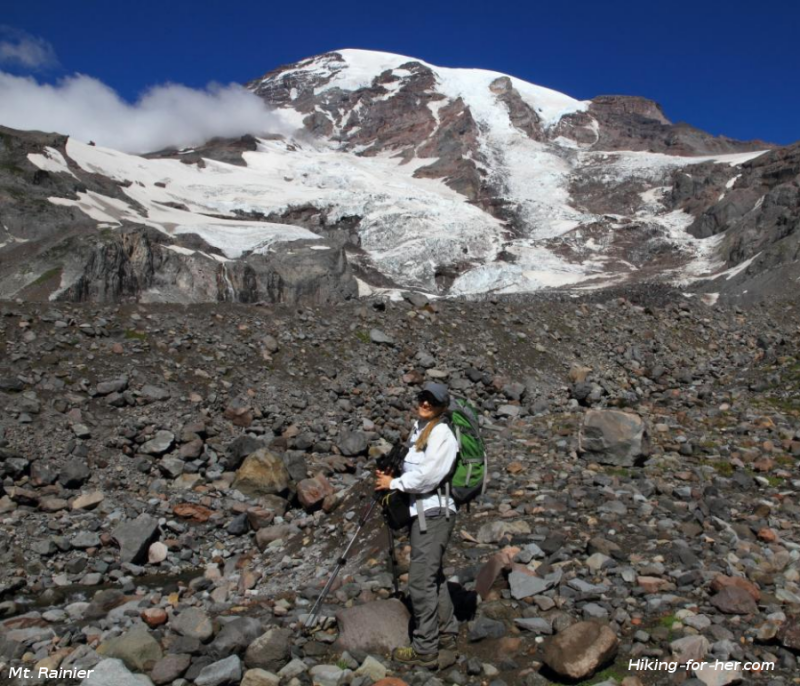
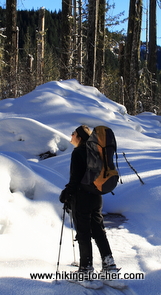 Looking uphill and calculating the hiking pace I'll need to get to the ridge.
Setting a hiking pace in groups
A quick word about pacing rules for hiking in groups:
The slowest hiker sets the pace for the group.
If you don't like that rule, don't hike with groups.
Why?
Because it's a smart trail strategy to stay together, or at least stay in pairs.
Having hikers strung out along the trail is asking for trouble, unless each of them is a strong, well-equipped hiker with navigating skills and common sense.
Too much can go wrong in the outdoors to allow an inexperienced slow hiker to remain alone on the trail.
The trip leader should make the decision about whether the group splits up into smaller groups or not, and how to adjust the hiking pace.
Putting the slowest hiker at the head of the line works well if the other hikers are able to mentally adjust to a slower pace.
And if you're the slow hiker, don't feel bad.
Hiking in groups requires different pacing than hiking solo or with just one hiking buddy.
Ditto for hiking with kids.
Bottom line:
- Anyone who goes group hiking should be willing, if not eager, to accommodate the slowest hiker, and not get snarky about a slower pace.
Tools to help you set, and keep,
a good hiking pace
for your goals
You're a prepared hiker.
You've selected an objective, and have determined your route on a map.
You've got plenty of daylight, and lots of energy.
Now for the hard part: pacing yourself.
Why not let technology lend a helping hand? Or, if you prefer, a wrist?
Back in the day, a watch on your wrist was just a watch: keeping watch on the passage of time.
How quaint.
Step into the 21st century!!
Today, you can strap more than just a time keeper onto your wrist. A smart watch!
A digital hiking watch gives you lots of data to factor into your hiking pace and plans:
- pressure-based altimeter to check your progress snf location against your topographical map
- barometer to keep track of changing weather conditions (important when rain is moving in)
- thermometer (so you know ahead of time when the water in your bottle will freeze)
- date and time (because it's easy to lose track on the trail)
- timer, alarms, stopwatch (useful for backpacking meal prep and sticking to your turn around time)
- backlit display for early morning or late evening hiking
- water resistance so a foggy day or rain squall won't affect it.
Go big or stay home?
To kick things up a few notches, a hiking GPS multifunction watch does even more for you on the trail:
- programmable routes and breadcrumb trail as you progress along the route
- locations can be stored (for putting in up to 250 way points, or marking your favorite spots)
- step and calorie tracker (love this feature!!)
- compass
- GPS/satellite detectable
- visual map display
- on line app to store your data
Hint: If you're looking for a fantastic gift for your favorite hiker, or need a few items to put on your own wish list, check out these watches.
All of the data they provide will keep you, or your loved one, oriented and notify you of your turn around time, hike after hike.
Your pace is your own
I'm a "not too fast, not too slow" kind of hiker.
I like to stretch a little at the trail head.
Then I get started at a slow, reasonable hiking pace and ramp up from there to the optimal speed, given the terrain, weather conditions, and how my legs are feeling that day.
And I make adjustments frequently.
But you're not me, nor would you ever want to be!
So to sum it up (get it? summit up?):
Pacing on the trail is personal.
Your approach to the trail depends on many factors, some of which you can't control.
And it varies day to day, hike to hike.
Start off a hike with a pace that's right for you, and adjust as needed throughout the hike.
Be smart enough to avoid injury by being smart enough to allow your brain to listen to the pacing feedback from your joints, muscles, and bones.
After all, they're doing all of the work!
Best Hiking Pace Tips


Diane Spicer founded the Hiking For Her community in 2008 to encourage female hikers, those who wanted to begin hiking as well as those who were in love with this fantastic sport already.
On this website she shares expert hiking tips and recommendations, gear reviews and photos from her outdoor adventures to welcome everyone to learn the necessary skills for comfort and safety on a hike.
This reader supported website does not use sponsored or promoted content. There are no ads or paid link placements. Everything you read is based on decades of personal hiking experience in many different locations.
All rights reserved.
Photo credits: All photos on this website were taken by David Midkiff or Diane Spicer except where noted.
Disclosures
Privacy
Copyright
Media
As an Amazon Associate, Hiking For Her earns from qualifying purchases.
When you buy through our links to trusted outdoor gear affiliates, we may earn a commission while you pay nothing extra.