
Enjoy Happy Trails, the free monthly newsletter from Hiking For Her
Receive a free resource: "Hiking Layering System Explained"
Hiking Water:
Why It's So Important To Your Hike
By Diane Spicer
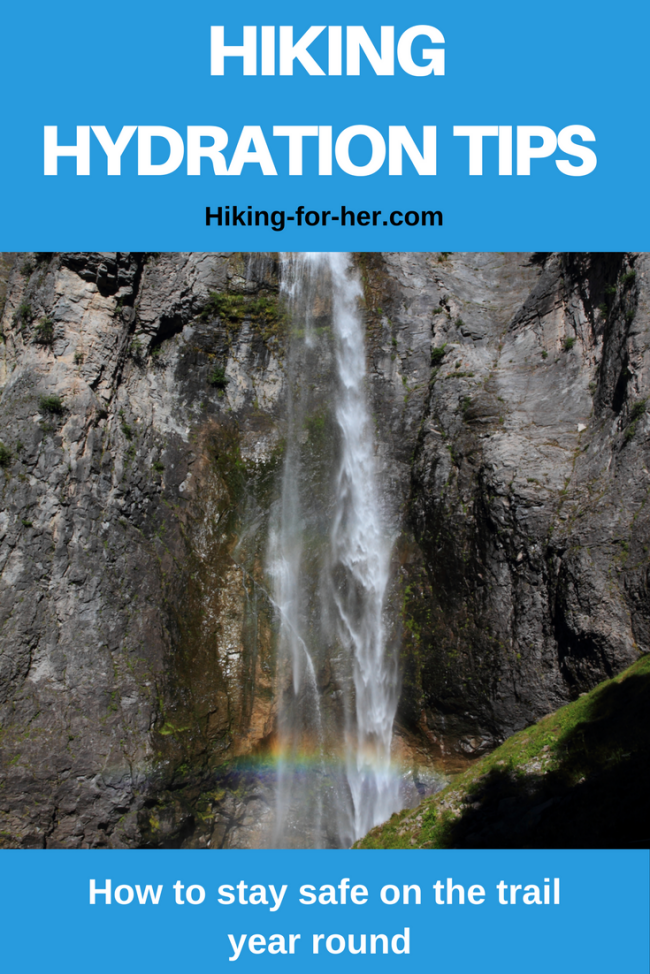
Why is hiking water so darn important?
Here's the obvious reason: to avoid cramps, lethargy and a huge thirst sensation.
- Drinking water on a hike to stay hydrated is simply common sense.
But there is a lot of nuance around how often to drink water on a hike, the best way to carry it, how to enhance it, and more.
Let's take a look!
How often should you
drink water on a hike?
It won't surprise you to learn that there are no hard and fast rules about when to take a water break on a hike.
It's a matter of "it depends".
The amount of hiking water you require depends upon:
- the weather conditions
- the activity level correlated to the terrain you're navigating
- the amount of weight you're carrying
- your size
- your fitness level
The renowned Mayo Clinic has these guidelines for staying hydrated during exercise, and you can use those during a hike.
Or you can create your own set of Hiking Water Best Practices, based on where and how you hike.
Hiking water best practices
Having enough water in your body isn't just about stopping for water breaks when you're thirsty.
You can do yourself a huge favor by pre-hydrating: Drink several cups of plain water before you begin your hike.
- Your kidneys will call for frequent "pit stops" as you hike, but it's worth it.
You can also help your body post-hike by drinking a quart or two of water right after you take off your boots. This takes discipline, to strip off sweaty socks and park yourself for half an hour as you sip.
Totally worth it!
What about how much water to drink while on the trail?
Staying well hydrated should be a simple matter of drinking when you feel thirsty, right?
Some experts recommend "drinking to thirst".
But I am cautious about this approach.
By the time you "feel" thirsty, you've already lost a lot of water via perspiration and respiration (open mouth breathing on an up-slope, for instance).
Allowing yourself to become dehydrated is setting yourself up for hiking inflammation.
It's better to drink every 45 minutes, than to run up a water deficit you will need time (and lots of water) to recover from.
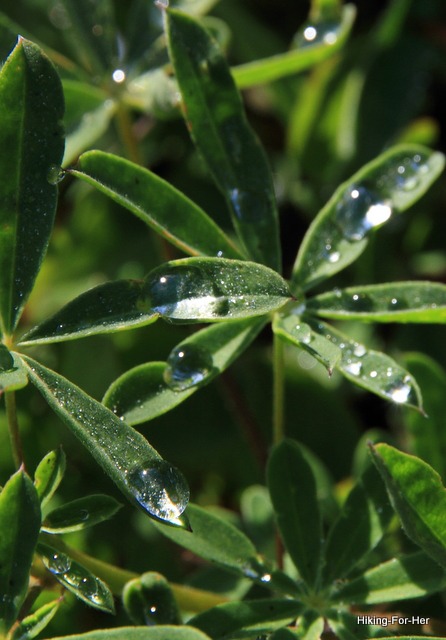 Hiking water: every living thing needs it, not just hikers!
You may prefer to push on, ignoring thirst signals, until you reach your destination.
If that sounds like your hiking style, here's a perfect solution: a hiking hydration backpack carrying a water reservoir (bladder).
- A convenient method for good hydration habits!
- These systems carry additional responsibilities regarding cleanliness and maintenance, and can be pricey.
- It's impossible to gauge how much water you're ingesting, so you might under-hydrate and set yourself up for a headache later. Or run out of water before you know it.
- If you invest in this technology, please commit to caring for it after every hike.
How much water to carry hiking?
Again, it depends completely on your hiking style.
Here's my routine:
On cool hikes, I bring a liter of water in a water bottle, and might have some left at the end of the day if temperatures are really low.
- That's when pre-hydration and post-hydration habits help me stay "juicy".
For warmer weather hikes, I carry at least two liters for a day hike if I'm hiking in an area without access to surface water.
I also carry a backup method of water treatment, if I need to dip into surface water sources.
And on backpacking and backcountry trips, I use those same methods to make sure my water is drinkable. The exception: my backcountry trips where water treatment is unnecessary.
Bottom line
On dayhikes, bring your own water. It saves time and eliminates any hesitation about its potability.
On longer trips, if there are surface water sources, why carry it?
Instead, carry the technology you need: filter, tablets, stove and fuel.
- Purify your water when you need it, thus lightening your backpack.
Caveat for backpackers: Study those maps along with trip reports to be sure your water sources will be there for you.
Water purification tips
You will need some sort of purification method when you're relying on surface water for hydration.
This is especially true if you're hiking the Appalachian Trail or other popular trails.
- Drinking contaminated water could leave you with very unpleasant, debilitating giardia symptoms.
- It could also expose you to viruses you won't get rid of, such as hepatitis A.
To avoid these problems, read these water purification tips.
Or carry a lightweight LifeStraw for short trips.
- Read my review here.
Hiking water bottles:
your choices are many
I carry water bottles on the outside pockets of my pack, stopping for water breaks throughout the day.
I like the fact that I have to be mindful about taking water breaks.
- This gives me a chance to have a snack break, too.
I have several favorites for water bottles, both plastic and metal.
Plastic is lightweight and allows me to see how much water I've got left at a glance. I carry:
- Tried and true (BPA free) wide mouth loop topped Nalgene bottles
- Fold-down-flat Platypus bottles, for a tiny footprint in my backpack if I don't need to carry them full of water or I want a backup bottle just in case
Metal bottles hold up well under lots of trail abuse, accidental or otherwise:
- Kleen Kanteen metal water bottles for extra durability and non-reactivity with electrolytes.
- HydroFlask insulated metal bottles, in various sizes for keeping your hiking water cold on a warm day. Read my review here.
Types of hiking water
to consider on a hike
What should you swallow to keep your body hydrated throughout a hike?
Your choices include:
- Plain water (either tap or filtered) but not distilled water
- Sports drinks
- Turbo-water
Again, let me share my choice and explain why it might appeal to you.
Hiking For Her hiking water preference
I'm a minimalist by nature (pardon the pun).
I figure that Mother Nature has limped along with plain old water for awhile now, and my body's biochemistry is well adapted to the humble H-2-O molecules.
I don't hike hard enough on any given day (unless you count the 12 hours days I log in the Arctic, thanks to eternal summer daylight) to lose electrolytes at a rate which can't be replaced with trail snacks and water breaks.
I don't hike in extreme heat or altitudes over 8,000 feet, which may create conditions where electrolyte loss is a serious concern.
So take my words with plenty of grains of salts (and sugars) if you do.
Also, I RUN AWAY from artificial colors, flavorings, preservatives and flavor enhancers out of respect for my hard-working organs of elimination: liver, kidneys, skin.
So that leaves me with just the plain old wet stuff: no carbonation, no flavors, no sugars (do a back-of-the-envelope calculation on what you're paying for that tiny dose of sugar & salt in your sports drinks).
I know that a lot of hikers will disagree with me. Taste buds rule, no doubt.
I agree that a plain fluid in your hiking water bottle is pretty dull compared to razzle-dazzle brand name sports drinks.
But again, it circles back to respect for basic biochemistry.
Each one of my trillions of cells is asking for that basic solvent molecule called H - two - oh, and I'm happy to supply it.
 Look at all those water molecules in a hurry to go somewhere!
Old dog learns new hiking water trick
Recently, I had the opportunity to add some electrolytes to my hiking water bottle.
Amazingly, the day after my long, strenuous, hot hike, I was completely without aches, pains, or fatigue in my muscles.
I'm not exaggerating: completely free of post-hike issues.
Being a skeptical scientist, I repeated the "experiment" on the next hike, an equally long, strenuous, but slightly less hot hike.
I also used a different electrolyte product.
To my astonishment, the same results: no issues in terms of soreness the next day!
So now I'm backing off my "plain H-2-O only" advice.
- But I still advocate avoiding artificial colors and flavors.
Powdered electrolyte brands
Let's take a quick look at the brands of electrolytes I now use in my hiking water bottles.
Ultima Replenisher packets are easy to transport, and essentially weightless in your pack.
I have to admit that I look forward to rest stops so I can enjoy the fruity flavor (lemon, raspberry, orange yummy goodness)!
A few tips:
- I prefer the packets because the large canister gets a bit "grainy" and hard to dissolve if I don't use it up quickly.
- Plus, the packets are tiny sticks which are super convenient (I always stash a few extras in my emergency kit).
- Buying in bulk guarantees cost savings, too.
The other brand I rely upon is Natural Hydration (Nuun) tablets.
Try all of the flavors.
If you're lucky, you'll like them all and be able to get a variety of welcome taste "hits" on a long hiking trip, every time you take a sip of your hiking water.
More additions to your water bottle
In both Ultima and Nuun, there are water soluble B vitamins and vitamin C in these tablets along with the electrolytes, which is a nice add-on.
- Sodium, chloride, potassium
Note: If you're looking for a full complement of minerals that your cells need, including calcium, copper, and molybdenum, adding just these to your hiking water won't do it for you.
- Rely on the right nutrients in your hiking food for that.
If you're interested in a quick shot of Vitamin C along with antioxidants in your hiking water, you might want to try these Emergen-C packets.
- I like this beverage warmed up after a long day of hiking, to sip as I'm setting up camp.
- During cold weather day hikes I heat it up at home and carry it in a thermos (see below). Sipping this beverage at rest breaks keeps me hydrated AND warm.
One more note on vitamin C and
hiking water for backpackers
It gets tough to find great vitamin C sources for a long hiking trip, and Emergen-C packets not only satisfy me.
- They contribute to good blood vessel health and strong immune function while I'm putting my body through its paces day after day.
Read my tips for more sources of vitamin C while backpacking here.
Antioxidant tips here.
Did you know?
You need hiking water year round
Don't overlook the fact that you can sweat hard and lose electrolytes during a winter hike, especially while winter hiking and snowshoeing.
I bring along a thermos like this so I can keep my muscles contracting mile after mile after.
- Be advised that a heavy duty thermos will in fact be a bit heavy. Only you can decide if the warm beverage containing electrolytes is worth it!
You can read about my field trials with a HydroFlask double walled insulated metal bottle for cold weather hiking, here.
Three big ways to look at your hiking water
There are three ways a hiker can appreciate water.
You can look at this amazing clear, refreshing fluid through a chemist's lens:
Water is a molecule composed of two hydrogen atoms bonded to an oxygen atom, conferring remarkable properties for
- heat storage
- solubility
- dissociation
You can regard it through the biology lens:
- You've got to replace what you lose via respiration, perspiration, urination, and defecation.
- Kidneys need water to filter your blood and avoid making kidney stones.
- Electrolytes dissolved in water keep your heart, brain and muscles ticking along.
Or if all that is too science-y for you, just regard hiking water as a geologist does:
- a freely available resoure for you during a hike: streams, rivers, ponds, waterfalls, lakes.
But whichever approach you adopt, don't ignore how important it is to drink enough water on a hike.
One more way to enjoy hiking water
Don't forget how much fun it is to PLAY in this amazing clear liquid, provided by Mother Nature for our pleasure!
Devote a little of your trail time this season to appreciating the beautiful lakes and streams of our planet by ingesting, and frolicking, to your heart's content (and I mean that quite literally).
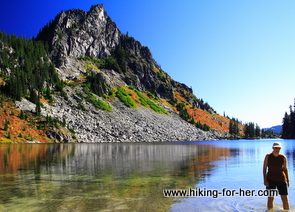 Outstanding in her hiking water
Now that you're well hydrated, how about some tips for the best hiking food?
Home page > Best Hiking Tips >
Hiking Water
Some of the links on this page and elsewhere on Hiking For Her allow you to make a purchase AND donate to the maintenance of this website.
It costs you nothing extra, yet it helps to keep this free hiking information flowing to everyone.
Thank you!

Diane started hiking in 1971. She started Hiking For Her in 2008 as a resource to encourage every woman to take a hike. Please enjoy these expert hiking tips as you explore what hiking offers in any weather, season or location.
Meet Hiking For Her's Diane
TODAY'S BEST OUTDOOR GEAR DEALS
REI Co-op Members save an extra 25% on REI Outlet fitness clothing & gear 4/12 thru 4/15.
Example: Hydro Flask bottle with cap, marked down from $49.95 to $26.73.
Use code OUTFIT24.
See ALL the great deals on the Hiking For Her Best Current Deals page!
POPULAR POSTS



Diane Spicer founded the Hiking For Her community in 2008 to encourage female hikers, those who wanted to begin hiking as well as those who were in love with this fantastic sport already.
On this website she shares expert hiking tips and recommendations, gear reviews and photos from her outdoor adventures to welcome everyone to learn the necessary skills for comfort and safety on a hike.
This reader supported website does not use sponsored or promoted content. There are no ads or paid link placements. Everything you read is based on decades of personal hiking experience in many different locations.
All rights reserved.
Photo credits: All photos on this website were taken by David Midkiff or Diane Spicer except where noted.
Disclosures
Privacy
Copyright
Media
As an Amazon Associate, Hiking For Her earns from qualifying purchases.
When you buy through our links to trusted outdoor gear affiliates, we may earn a commission while you pay nothing extra.