
Enjoy Happy Trails, the free monthly newsletter from Hiking For Her
Receive a free resource: "Hiking Layering System Explained"
Arm Injury Prevention
On A Hiking Trail
By Diane Spicer
A discussion of arm injury prevention while hiking might not make any sense to you at first glance:
How would a hiker injure an arm?
- The answer depends upon the terrain, the weather, and lots of other factors.
Sure, on a well maintained, wide and flat trail, chances of arm injuries for hikers are slim.
Cherry picking your trails keeps you safe while hiking.
But does everyone stick to well groomed, wide-enough-to-drive-on hiking trails?
I sincerely hope not!
Otherwise, you are missing a lot of fun.
So let's get down to business.
Singing the praises
of a hiker's arms
Arm injury prevention for hikers involves a dose of common sense AND an understanding of the way your arm is connected to your trunk.
Can you think of a better appendage for a hiker? A freely movable limb that is anchored securely at one end, and is able to grasp objects* at the other end!
Woohoo - what a deal!
And you have 2 of them for grasping objects* such as
- a hiking pole,
- your ten essentials,
- tipping back your water bottle,
- a bird feather on the trail,
- the lunch sack...
Ah, but I digress. (It must be near lunch time!)
So where is your arm,
anyway?
That's not a trick question!
Technically, your arm is just the portion of your upper limb from your shoulder joint to your elbow joint. The rest is the forearm, joined at the wrist to the hand.
So there must be a bunch of bones in there, right?
Oddly enough, it doesn't take many bones to do the job:
- the long arm bone (humerus),
- two shorter forearm bones (radius and ulna),
- and that's pretty much it. (Your wrist and hand bones become more plentiful, and somewhat complicated, in comparison).
The upper end of your arm bone rests in the shallow shoulder socket provided by your shoulder blade bone (scapula).
Your arm sacrifices stability for mobility: you can swing your arm wildly in comparison with your stable, relatively immobile hip joint.
So what does that mean for hikers? An opportunity to overdo it with the shoulder and elbow joints, if you aren't careful.
How?
Asking the arm and shoulder to do too much work, especially if you haven't warmed up properly, for starters.
- Think about jumping out of the car after a long ride to the trail head, lacing up your boots quickly, and hoisting up your pack. Off you go!
Arm muscles
But you may be asking a lot from your shoulder and arm muscles, of which there are plenty.
Major arm muscles include some you have probably noticed on athletes and celebrities:
- biceps and triceps, for instance.
There are other smaller muscles hidden beneath these, which connect the upper body with the elbow area.
Soft tissues in your arm
These muscles cling to the bone via tendons, and the bones join together to form joints partly due to ligaments (tough ropey connections).
It's possible to ask these soft tissues to do too much work if you:
- Pick up a heavy pack without using your back muscles or knees to help.
- Pull yourself up on a rocky ledge when the muscles are not trained to doing that type of work.
- Lift heavy loads like children or backpacks without a warm up.
The result?
Sore arms, at the very least.
Or an arm soft tissue injury that takes months to heal.
- Inflammation can be a double edged sword.
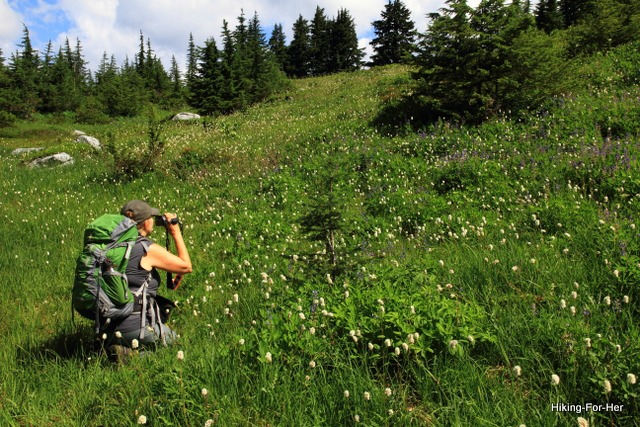 Arm injury prevention makes you ready to do other things with your arms!
Arm injury prevention tips
begin at home
So what would arm injury prevention for hikers look like?
You probably already know the answer: get strong, and stay strong.
How?
Do some weight lifting at home.
It doesn't take much: even 3 pound weights used for 10 minutes each day can show you a big difference in arm strength.
And you don't even need to buy weights: make your own!
- Fill 2 of your hiking water bottles, and use those.
- Then drink the water when you're finished, to keep hydrated.
When three pounds feels too easy, you're ready for heavier weights.
Here's another approach:
- bring your own bags with strong handles to the library or grocery store and give your arms a workout toting home the goodies.
Carrying babies and toddlers counts, too!
Swimming is another great way to give your arms some work without straining the joints.
If you'd prefer to tone up and strengthen your arms without weight bearing, yoga may be the way to go.
Arm injury prevention
on the trail
On the trail, arm injury prevention requires a bit of mental discipline.
I myself have been guilty of doing stupid things with my arms:
- waving them wildly in front of me to clear prickly brush, spider webs, and dangerously sharp blow downs.
But wait, there's more to share...
- sticking them into murky water with no
idea of what was beneath me (think jagged rocks or sharp sticks),
- falling on my arm instead of rolling to my back as I slid down a talus
slope,
- pushing heavy objects out of the way using my arms rather than
the strength of my back or thighs,
- and the "don't do this" list goes on.
So let's get to the point here:
Don't use your arms as levers to pick up too much weight unless you are confident that you are strong enough to pull it off safely.
And don't sacrifice the safety of your arms when you have other tools to use: your strong legs, your hiking poles, a long stick, etc.
Tips to try
to save your arms
Need a few tips on how to safely hoist your backpack? Here they are!
More tips:
- Wear long sleeves during off trail navigation.
- Use your hiking poles/sticks to help you clear a route or probe murky or fast moving water.
- Don't max out your joints by overexertion or weird arm positions as you navigate brushy blow downs on the trail.
- If you trip over something and are falling, avoid using your arm as a brace against your fall. (Although in the heat of the moment, a natural instinct is to do just that.)
- Know what to do when you get a cut or scrape.
Reasonable reasons
Of course, there are some very good reasons for hikers to rely upon the strength of your arms while hiking, and that's why you want to have strong ones regardless of how many birthday candles are on your cake.
Reasons such as:
- doing a bit of rock scrambling (Class 2 and above by definition require the
use of arms),
- getting up and over trail obstacles such as blow downs and wash outs,
- scoping out a "secret" waterfall or viewpoint off trail that requires some bush whacking,
- setting up a bear bag,
- carrying filled water bottles back to base camp for an evening meal,
- using fixed rope belays over short sections of trail.
And then there's the most excellent reason of all: doing the Y-M-C-A song before turning into your tent after a long, happy day on the trail.
Email me if you don't know what I'm referring to ;)
Home page > Injury Prevention >
Arm Injury Prevention Tips

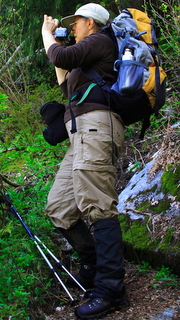
Diane started hiking in 1971. She started Hiking For Her in 2008 as a resource to encourage every woman to take a hike. Please enjoy these expert hiking tips as you explore what hiking offers in any weather, season or location.
Meet Hiking For Her's Diane
TODAY'S BEST OUTDOOR GEAR DEALS
REI Co-op Members save an extra 25% on REI Outlet fitness clothing & gear 4/12 thru 4/15.
Example: Hydro Flask bottle with cap, marked down from $49.95 to $26.73.
Use code OUTFIT24.
See ALL the great deals on the Hiking For Her Best Current Deals page!
POPULAR POSTS

Diane Spicer founded the Hiking For Her community in 2008 to encourage female hikers, those who wanted to begin hiking as well as those who were in love with this fantastic sport already.
On this website she shares expert hiking tips and recommendations, gear reviews and photos from her outdoor adventures to welcome everyone to learn the necessary skills for comfort and safety on a hike.
This reader supported website does not use sponsored or promoted content. There are no ads or paid link placements. Everything you read is based on decades of personal hiking experience in many different locations.
All rights reserved.
Photo credits: All photos on this website were taken by David Midkiff or Diane Spicer except where noted.
Disclosures
Privacy
Copyright
Media
As an Amazon Associate, Hiking For Her earns from qualifying purchases.
When you buy through our links to trusted outdoor gear affiliates, we may earn a commission while you pay nothing extra.