How To Choose The Best Trails
For Solo Hiking Women
By Diane Spicer
Here's what you need to know about how to choose the best trails and routes for solo hiking women.
And along with that information, how to enjoy your hike.
You'll feel confident starting your solo hike because you know you have a good route and have taken every precaution for a safe and enjouable hike.
Jump to the topic that jumps out to you, but read all of the tips on trails for solo hikers to get a complete picture of how to pick the best hike for you.
T3 tips:
SERP is mostly general solo-hiking tips and forums; a simple, repeatable route-vetting framework can stand out.
Top results are dominated by “best trails for solo hikers” lists, broad solo hiking tips/safety articles, and community threads. Depth rewarded is mostly overview, with a notable gap for systems-based route choice: a calm, confidence-building framework for route-shape decisions, turnaround rules, navigation simplicity, bailouts, and cell-coverage tradeoffs.
Which types of trails are best for solo hiking?
The answer to that question is "a safe, easy to navigate trail that builds your confidence."
Approach the task of choosing the best type of trail for a solo hike with those two words in mind: safety and confidence.
Read this first if you're uncertain about how to begin looking at types of hiking trails.
In terms of safety for a solo hiker on an established trail, keep these questions in mind:
- What should a solo hiker look when reading trail descriptions?
Every good trail description gives you basic facts that are important when choosing the best hiking trail for going solo.
You want to know these things right up front:
- Shape of the route (sometimes described sometimes evident on an attached map)
- Distance of the hike
- Options for increasing or decreasing the distance
- Elevation gain and loss
- Trailhead permits you need
Tier 4: How to choose a solo hike with easy turnarounds and clear decision points
- Which shape of route is the best for a safe solo hike?
Answers for T4:
Out-and-back allows you to control how far from a trailhead you hike, and gives you a direct route back to your car. It forces you to retrace your steps, navigating any pinch points or hazards along the way. You might not like backtracking, though.
A loop hike gives you fresh scenery to enjoy while bringing you back to the same trailhead. If you crave variety, this is a great choice for a solo hike.
A lollipop hiking trail is different than a loop because combines those two types of trail. Visualize the "stick" of the lollipop as an out-and-back segment combined with a loop at the far end of the route. You get fresh vistas in the middle of your hike, with a known segment to end. This is a good choice if you're fairly confident in your solo hiking skills, giving you a bit of a challenge but taking you back on a direct route.
There is a lot to say on each topic, so use those links to my detailed tips on which solo hiker.
Should I
choose a trail I've already hiked
for my first solo hike?
Underlying solo hiker safety concerns is confidence. You want to choose a trail that you can tackle without too many challenges.
If you have a bad experience with your first few solo hikes, you will swear off solo hiking forever.
Consider choosing a familiar trail, one you've done before and enjoyed.
T4: Why choosing a familiar trail for a solo hike is smart.
That's a smart move for a couple of reasons.
If you're familiar with the trailhead and route, you can navigate the trail with confidence. Even if something has changed on the route, like blow downs after a storm or trail junctions that have moved, you will feel good about being able to navigate to your destination.
The other reason to hike solo on a trail you've hiked before is pacing. You know that you can complete the hike in good time, because you did it before. Solo pacing is different, though, so you can focus on what changes, and experience what it feels like to move down a trail by yourself.
You might be in for a surprise. Often when I'm solo I take longer to hike a familiar trail because I stop more often for photos or wildlife viewing. But maybe your solo pace will be faster than you expect.
It's always fun to note how things change when you hike solo!
Here's one more reason to choose a familiar trail. Picking a turnaround time is easier than if you pick an unknown trail, which keeps you safe from having to hike out in twilight.
Solo-specific route-shape decisions (out-and-back vs loop vs lollipop) tied to safer judgment and easier turnarounds
Tier 4: Out-and-back vs loop vs lollipop: which route shape is best for solo hiking?
Tier 4: Why should a solo hiker pay attention to spur trails?
Tier 4: How to choose a solo hike with easy turnarounds and clear decision points
Not mine: rewrite everything
A spur trail is a short side trail that branches off a main trail to reach a specific destination — such as a viewpoint, summit, water source, campsite, or point of interest — and typically dead-ends there, requiring you to backtrack to the main trail. Recognizing spur trails and not mistaking them for the main route is a basic navigation skill, especially at unsigned junctions.
How do you avoid getting confused by spur trails?
Pay attention at junctions, read any signs, and consult your map — a spur is usually shorter and leads to a specific feature, while the main trail continues onward. The risk is accidentally following a spur and then a dead-end, or mistaking the main trail for a spur. Noting the junction so you can find your way back is good practice.
Why do trails have spurs?
Spur trails let hikers access worthwhile destinations or resources that lie just off the main route without having to reroute the entire main trail through them. For example, a spur might lead a short distance to an overlook or a spring, giving you the option to visit while keeping the main trail efficient and direct.
How to pick a first solo hike trail
and route along that trail
Once you've chosen a hiking trail for your solo hike, you need to decide how you are going to hike it.
What does that mean?
It means choosing the best distance for your hike without pushing your limits. Do you want to reach a specific destination, or simply set a turnaround time and enjoy the trail experience as it unfolds.
As we noted above, a hiking trail gives you the options of out-and-back, loop, or lollipop.
Other things to consider along the route: availability of surface water if you haven't carried enough,
the elevation gain and loss because that impacts your hiking pace. A general rule: for every 1000 feet of elevation gain, it costs you about an hour of hiking time.
You also need to keep in mind what you will do if you need to leave the trail early. Hikers call these bailout options and early exit points.
[How to pick a first solo hike route that builds confidence step-by-step (without pushing distance)
Tier 4: How to choose a solo route with realistic bailout options and early-exit points
Tier 4 page: How do I vet a hiking route for solo safety without overthinking it?
Are dog-friendly routes better or worse for solo hikers?
{It depends. Dog-friendly often means popular and well-used, which some solo hikers like. But it can also mean more distractions or unpredictability on narrow trails.}
Checklist you can use to select the best trail
for your solo hiking plans
Tier 4: A solo
hiker’s route-choice checklist: navigation, traffic, bailouts, and
daylight margins
Tier 4: How to choose routes when you might lose cell service (and what to do instead)
Trailhead checklist before you start your solo hike
A practical trailhead/access checklist (parking, start-time, remoteness, “what if I need to stop early?”) in a calm, confidence-building tone
Best safety practices for female solo hikers
You have several options here to protect your personal privacy.
You can use your first name, last initial and put "2" where it asks how many hikers. Be sure to use the correct date and destination, because .
You can use a fake name and put "2", but let someone back home know this name in case someone has to come looking for you. Be honest about date and destination.
You can skip the trail register sign-in step.
What to do if your solo hike doesn't go
as planned
What if the weather changes — how should that affect my route choice?
Choose routes with easy shortening options and fewer exposed sections when weather is uncertain. A “plan B” route is often the best solo decision.
Should I avoid routes with stream crossings when solo? (if a crossing you weren't expecting, or is tougher than expected, or bridge washed out)
Not my words; re-org:
If you do get lost: stop and stay put.
Search and rescue groups teach a simple rule called STOP: Stop, Think, Observe, Plan. The instinct when you realize you are lost is to keep moving and fix it. Usually that takes you further from where anyone will look.
If people know your route, staying near it is the fastest way to be found. Get warm, get visible, make noise with a whistle in sets of three, and save your phone battery for when you have signal. All of this works best when you know someone is already on the way, which brings us back to the call-out time.
FAQs
- What makes a route “solo-hiker friendly”?
- Is an out-and-back safer than a loop when hiking solo?
- How long should my first solo hike be?
- How do I choose a route that’s easy to navigate?
- How busy should a trail be if I’m hiking alone?
- Should I avoid routes with stream crossings when solo?
- How do I decide my turnaround time when hiking alone?
- How do I factor daylight into route choice?
- Does cell coverage matter for choosing a solo hike?
- How do I pick a trailhead I’ll feel comfortable starting from alone?
- What if the weather changes — how should that affect my route choice?
- Should I choose a route I’ve done before for my first solo hike?
- How do I choose between “scenic” and “simple” when solo?
- What’s a “bailout point,” and how do I build that into my route choice?
- Are dog-friendly routes better or worse for solo hikers?
More resources for choosing the best trails
for solo hiking women
https://americanhiking.org/hiking-resources/#hiking-101
Home page > Solo Hiking Tips >
How To Choose The Best Trails For Solo Hiking Women
|
I get emails all the time about what I wear, eat, carry and love to use on the trail. That's
why I provide affiliate links to you: the best gear that I use myself and have seen used by other hikers is instantly
available for your consideration, and the gear company sends a few
pennies per dollar to this reader-supported hiking website. There is no added cost to you! Everyone ends up a winner: Great gear for you, strong gear companies, and more free hiking tips for everyone. Thanks very much for your support. It's warmly and sincerely appreciated. It also helps send these hiking tips to all your virtual trail buddies around the globe. |
 |
|
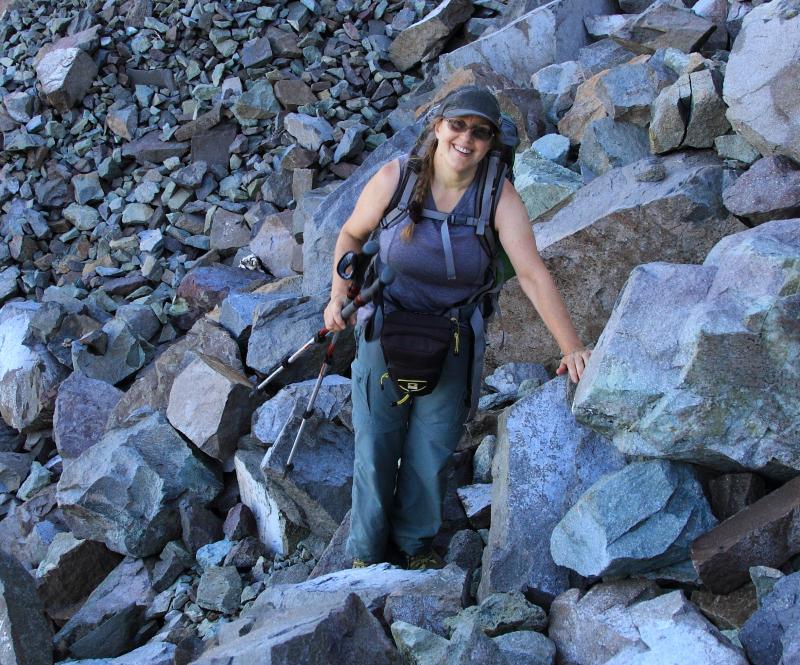
Diane Spicer was a beginner hiker in 1971, and never stopped hiking. She founded the Hiking For Her community in 2008 to encourage female hikers, those who wanted to begin hiking as well as those who were in love with this fantastic sport already. On this website she shares expert hiking tips and recommendations, gear reviews and photos from her outdoor adventures so you can learn the necessary skills for comfort confidence and safety on a hike. This reader supported website does not use sponsored or promoted content. There are no ads, no AI content or artificially generated or touched up photos, no paid link placements. Everything you read is based on decades of personal hiking experience in many different locations. Please enjoy these expert hiking tips as you explore what hiking offers in any weather, season or location. |
 |
Scraping the contents of the Hiking-for-her.com website for the purpose of AI (artificial intelligence) LLM (Large Language Model) training is strictly forbidden.
All rights reserved. No duplication of content without permission.
Photo credits: All photos on this website were taken by David Midkiff or Diane Spicer except where noted.
Disclosures
Privacy Policy
Copyright
Media
Hiking For Her is a participant in the Amazon Services LLC Associates Program, an affiliate advertising program designed to provide a means for us to earn fees by linking to Amazon.com and affiliated sites.