
Back Stretches For Hikers:
Pain Prevention
By Diane Spicer
Back stretches for hikers: such a smart idea.
Not only do your hard working back muscles deserve a little extra oxygen and stretching, but regular stretches are your ticket to back pain prevention as a hiker.
Hiking back pain will keep you off your favorite trails, and impact every other area of your life, too.
Stretching your large muscle groups = being proactive, and pain free.
Note: I'm differentiating between the "good sore" after a long hike, and ouchy pain of a sore back that signals a problem with a muscle group.
And no medical advice is being given here, only a few suggestions that have worked for me.
Back stretches for hikers:
where to start
First, you have to slay the dragon called "But I don't wanna do back stretches".
That "dragon" (or draggin') is a motivational issue, and the only advice I have is to visualize yourself with painful back spasms, writhing in agony on the trail and cursing your lazy self for neglecting your daily back stretches.
If you've got more gentle motivational strategies, please send them my way using the CONTACT box to your left on this page.
For now, let's assume you're plenty motivated, due to a recent episode of back pain.
- You've already read my suggestions for back pain relief here.
- And you agree that back stretches are a useful idea, or at least something you'd like to start.
Now what?
Keep reading!
Start off gently with back stretches
Hikers tend to be determined, driven folks.
So I caution you against jumping whole hog into incorporating extensive stretches into your hiking routine.
Instead, vow to incorporate stretches in a gentle, cautious way, as in some lower back stretches based on yoga poses.
Your muscles will feel so good after a stretch session like this, you'll want to keep at it.
Got a minute? Get your back stretched!
Here's an easy one to try right now. I mean it!
Right now,
- Stand up with your arms overhead, hands clasped together.
- Breathe in, a full belly breath.
- Pull your arms back until you feel a nice tug on your back muscles.
- Breathe out and bend over as you clasp your hands together behind your back.
- Tug your arms gently, feeling a nice little stretch in your back.
However,
if this type of gentle stretching is causing you a lot of pain (over
and above normal muscle soreness), you need a trip to your health care
provider to sort out the underlying problem.
Current medical thinking in the U.S. is to remain active during an episode of back pain.
- Read the latest here.
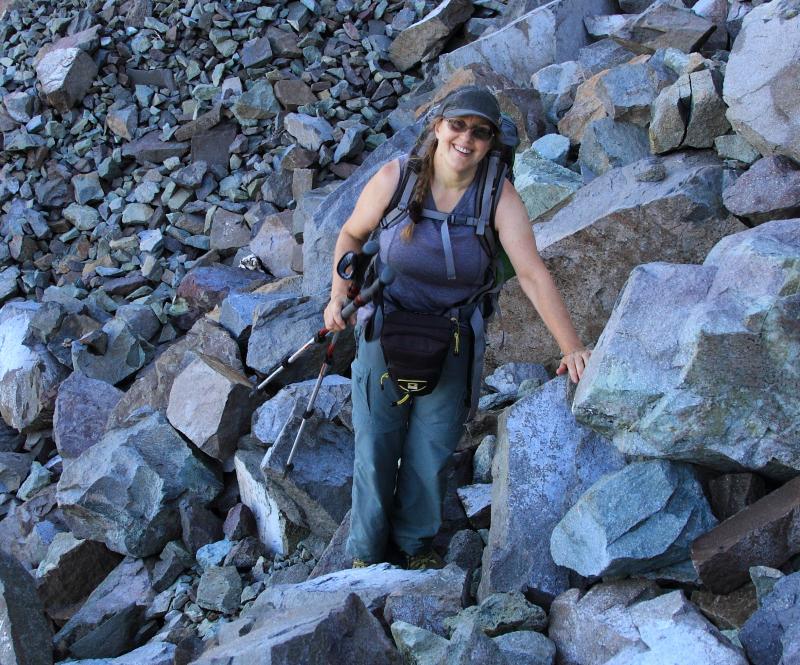
 Feels great to get the pack off and do some back stretches!
Strengthen your core muscles
After your pain is a distant memory, it's time to consider regular back exercises to:
- strengthen your core muscle groups and
- improve your ability to carry a backpack effortlessly.
These exercises (illustrated with photos to accompany the instructions) will improve your core strength, and yield huge dividends on the hiking trail.
But you have to find the discipline to do them! I find that self bribery works, and no, I won't share my bribery system. You know what works for you, right?
Stretching at the trailhead before and after a hike, also recommended, but again, self discipline is the key.
What else can you do to prevent
a sore back?
Hiking might not be the (only) culprit in your back pain.
What's your posture like?
If you really want to find out, put a mirror where you can catch a glimpse of yourself:
- sitting at your desk or dining table;
- driving your car;
- walking down a hallway.
Your daily activities train your muscles to hold you, and move you, in routine patterns.
Changing the strength and length of those muscle groups will improve your posture.
But becoming aware of your posture is the first step.
You could also ask someone to snap a few candid photos of you on the hiking trail. Then analyze them from the perspective of your back muscles.
- Are you being reasonable in your expectations of them?
- Or overburdening them with poor posture like thrusting your neck forward, or hunched shoulders?
Chronic pain avoidance with these tips
Break up your daily non-trail routine as much as possible to avoid chronic back problems like stiffness or weakness.
- Avoid sitting for prolonged periods of time, even on an air plane. Get up and roam around a bit to bring oxygenated blood to your muscles, and allow them to relax and elongate.
- When standing for a long time, give one foot something a bit higher to rest on. Alternate legs in order to give your low back a break.
- While seated at a desk or your work station, roll your shoulders and reach for the ceiling at least once an hour.
What, and how, do you sit and sleep on every day for 16+ hours?
- Make sure your car seat, chairs, pillow and bed support your spine.
All of these approaches to relaxed back muscles result in more flexible movements and a back that will cooperate in your intense hiking activities such as:
- lifting a day hike pack,
- scrambling over a downed log on the trail,
- carrying weight for prolonged time periods on a backpacking trip.
Here's a fun back stretches idea to try
If you have a cat, or like to watch cat videos, mimic the felines and stretch out on the floor just because it feels great.
- In a patch of sunshine on the rug, optional ;)
If these suggestions seem "too simple", don't dismiss them until you've tried them.
Sometimes, simple is just right.
Beyond back stretches for hikers
The reality?
It's your back, and your back pain to either live through, or avoid.
Sometimes back pain is a message asking you to change your habits, as outlined above (posture, sleep position, and more).
Other times, your sore, aching back is brought on by over exertion, disc deterioration, or an injury.
Pay attention to what you were doing before the pain presented itself, and what makes it feel better or worse.
Use that important information as a starting point to remove yourself from the back pain "club".
Back stretches are just one of the ways to do that!
Home page > Back Pain Relief >
Back Stretches For Hikers
|
I get emails all the time about what I wear, eat, carry and love to use on the trail. That's
why I provide affiliate links to you: the best gear that I use myself and have seen used by other hikers is instantly
available for your consideration, and the gear company sends a few
pennies per dollar to this reader-supported hiking website. There is no added cost to you! Everyone ends up a winner: Great gear for you, strong gear companies, and more free hiking tips for everyone. Thanks very much for your support. It's warmly and sincerely appreciated. It also helps send these hiking tips to all your virtual trail buddies around the globe. |
 |
|
Diane Spicer was a beginner hiker in 1971, and never stopped hiking. She founded the Hiking For Her community in 2008 to encourage female hikers, those who wanted to begin hiking as well as those who were in love with this fantastic sport already. On this website she shares expert hiking tips and recommendations, gear reviews and photos from her outdoor adventures so you can learn the necessary skills for comfort confidence and safety on a hike. This reader supported website does not use sponsored or promoted content. There are no ads, no AI content or artificially generated or touched up photos, no paid link placements. Everything you read is based on decades of personal hiking experience in many different locations. Please enjoy these expert hiking tips as you explore what hiking offers in any weather, season or location. |
 |
Scraping the contents of the Hiking-for-her.com website for the purpose of AI (artificial intelligence) LLM (Large Language Model) training is strictly forbidden.
All rights reserved. No duplication of content without permission.
Photo credits: All photos on this website were taken by David Midkiff or Diane Spicer except where noted.
Disclosures
Privacy Policy
Copyright
Media
Hiking For Her is a participant in the Amazon Services LLC Associates Program, an affiliate advertising program designed to provide a means for us to earn fees by linking to Amazon.com and affiliated sites.