Best Snowshoeing Food:
How To Fuel Up For Winter Hiking
By Diane Spicer
The best snowshoeing food tastes great, doesn't weigh a lot, and provides bountiful, easy to digest calories to fuel your winter adventure.
Can all of this be achieved in one little snowshoeing lunch?
Yes!
And here's the fun part...
Calories count! But don't count them
The best snowshoeing food is nutrient dense, providing lots of winter hiking fuel.
Calories, in other words.
If you're in the habit of counting calories for weight loss or maintenance, a snowshoeing hike is an exception to your rule.
Your body is doing a lot of important work when you snowshoe:
- Keeping your core body temperature in a normal range
- Giving your big muscle groups in your legs, arms and back all of the fuel needed to get you where you're going - and back
- Sending lots of energy to your brain so you can make good decisions about turn around time, handling weather changes, and route finding
So read up on hiking calories, and embrace the fact that all of your winter exertions are burning A LOT OF THEM!!
- For an exact calculation, go here and be surprised, really surprised.
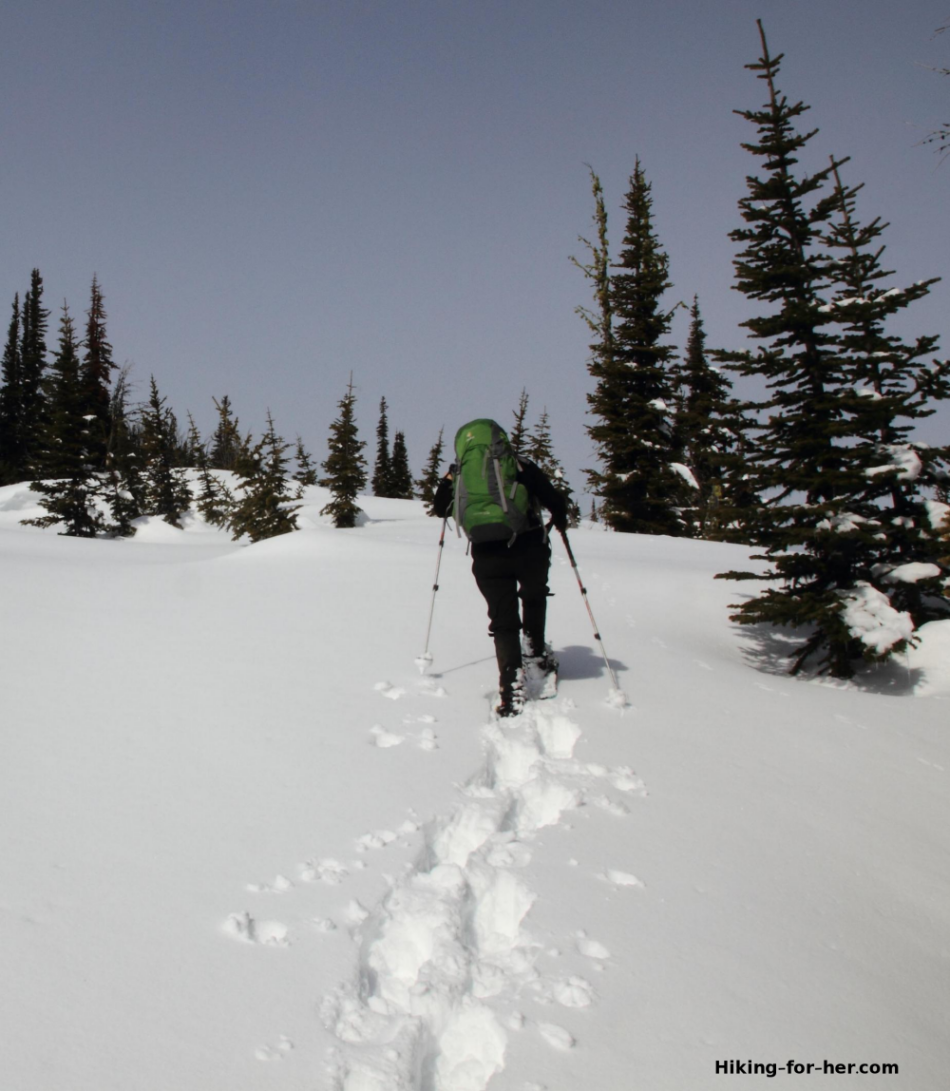 It takes a lot of calories to carry your gear and your lunch when you snowshoe. Especially when you're breaking trail like this.
The best snowshoeing food
doesn't freeze solid in your backpack!
So what are the best foods for winter hiking?
Think freeze-ability.
Even on a mild winter day, the temperature is low enough to damage watery or fragile food in your backpack.
Avoid these foods:
- Juicy fruit: oranges, apples, grapes
- Watery veggies: slices of celery, carrots, tomatoes
- Lettuce or sprouts on sandwiches
- Fresh berries
In addition to being filled with water, these foods are low calorie and not giving you much in the way of carbohydrates. They tend to get soggy, crushed, mushy and unpalatable in your backpack.
Not sure why carbohydrates are your friend during strenuous workouts like snowshoeing?
- Read up on carbs here
So what should a snowshoer bring for lunch?
Short answer: Something that doesn't take any prep after you pull it out of your pack, won't freeze quickly, and gives you fast energy.
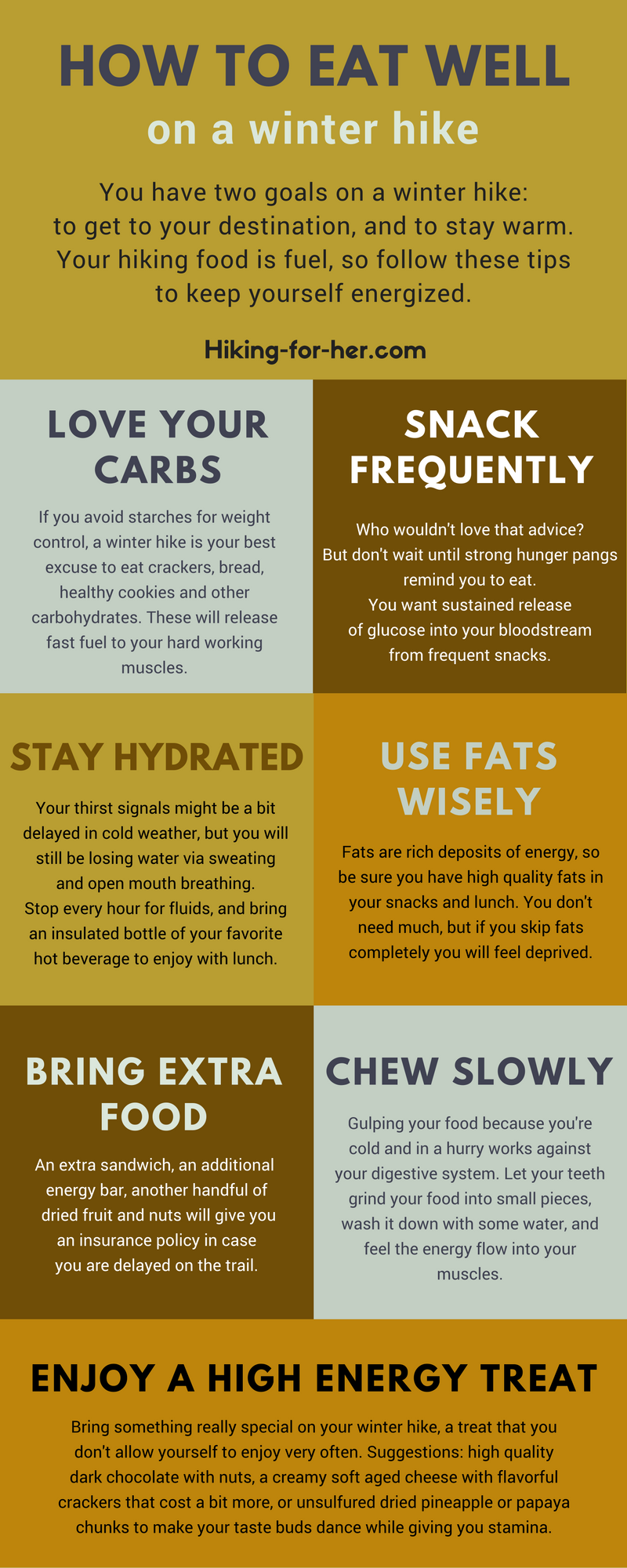
Here's what is in my backpack on a snowshoe hike, each and every time:
- Sandwiches packed full of energy: high quality nut butter & jam, turkey or tuna with cheese and mayo, hummus on a wrap
- Soft cheeses wrapped in wax, like the BabyBel brand
- High quality chocolate (and plenty of it!)
- Nuts and dried fruit: trail mix combos for energy
- Trail snacks that can stand up to the cold
Lots of options for the best snowshoeing food!
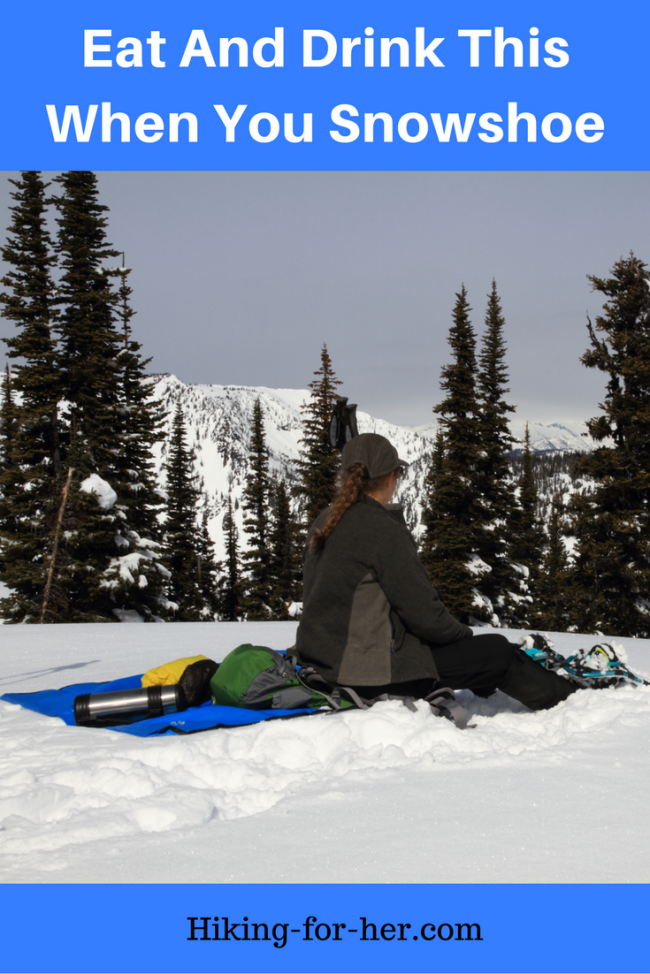
Bring a piping hot beverage, too
While water and sports drinks are great on hot summer day hikes, you might come to appreciate the lift to your spirits associated with a piping hot beverage.
When you pull it out of your pack, watch the appreciation wash over your trail buddy's face, too.
You'll need to find a suitable insulated container for your beverage.
I use a Hydro Flask like this one for this purpose. It has a closeable lid and will keep your tea or coffee hot for up to 12 hours, more than long enough to be out in the snow on your snowshoes.
While it is marketed as a leak proof lid, I never take a chance and always put it in a ziplock bag before stowing it in my backpack.
If I'm hiking with other folks, I bring something a bit beefier with a detachable stainless steel cup, this Thermos.
You could also use a larger Hydro Flask and remember to bring several cups.
What to drink while snowshoeing
Wondering what kind of beverage should you bring along to warm yourself up when you stop for lunch?
Skip anything with alcohol in it, because alcoholic beverages will cause your body temperature to drop. Sounds weird, I know, because you might feel warmer at first after a few sips of the hard stuff.
That's your brain saying "Hey, party time!" Not what you want if you snowshoe...
Instead, go back to the idea of calories as your friends on a snowshoe hike.
Put these hot combos into your body, and you'll feel warm and have lots of stamina to get back to the trail head, too:
- Oat milk and chai tea
- Hot chocolate made with any type of milk you enjoy
- Lemonade, ginger and green tea
Or use my simple favorite: piping hot chocolate almond milk. Yum!
My favorite teas might also be a good idea if you're into finding the best teas for hiking.
Grab lunch and get outside
If the idea of snowshoeing appeals to you, and you've never tried it, now you know what to eat and drink when you snowshoe.
To get started with this great winter sport, try these snowshoeing tips.
If you're an experienced snowshoer, don't forget how to stay safe out there.
And for everyone having fun in the snow, here's my best tip:
Eat well and often!
Save these on your Pinterest hiking boards for later.


Home page > Hiking Nutrition >
Best Snowshoeing Food
|
I get emails all the time about what I wear, eat, carry and love to use on the trail. That's
why I provide affiliate links to you: the best gear that I use myself and have seen used by other hikers is instantly
available for your consideration, and the gear company sends a few
pennies per dollar to this reader-supported hiking website. There is no added cost to you! Everyone ends up a winner: Great gear for you, strong gear companies, and more free hiking tips for everyone. Thanks very much for your support. It's warmly and sincerely appreciated. It also helps send these hiking tips to all your virtual trail buddies around the globe. |
 |
|
Diane Spicer was a beginner hiker in 1971, and never stopped hiking. She founded the Hiking For Her community in 2008 to encourage female hikers, those who wanted to begin hiking as well as those who were in love with this fantastic sport already. On this website she shares expert hiking tips and recommendations, gear reviews and photos from her outdoor adventures so you can learn the necessary skills for comfort confidence and safety on a hike. This reader supported website does not use sponsored or promoted content. There are no ads, no AI content or artificially generated or touched up photos, no paid link placements. Everything you read is based on decades of personal hiking experience in many different locations. Please enjoy these expert hiking tips as you explore what hiking offers in any weather, season or location. |
 |
Scraping the contents of the Hikingforher.com website for the purpose of AI (artificial intelligence) LLM (Large Language Model) training is strictly forbidden.
All rights reserved. No duplication of content without permission.
Photo credits: All photos on this website were taken by David Midkiff or Diane Spicer except where noted.
Disclosures
Privacy Policy
Copyright
Media
Hiking For Her is a participant in the Amazon Services LLC Associates Program, an affiliate advertising program designed to provide a means for us to earn fees by linking to Amazon.com and affiliated sites.