Sunburn Avoidance Strategies
For Women Hikers
By Diane Spicer
None of this information on sunburn avoidance is intended to replace your medical care providers.
Run everything through your own common sense filter, and bring your questions to your health care team.
While hiking in my big backyard, the Pacific Northwest, sunburn avoidance isn't the first thing which leaps to mind.
After all, opportunities for hot sunny days between September and June are minimal (yup, that's 10 months of the year with cool, cloudy weather. Morning marine layers are common.)
Basking in those ultraviolet rays from our star the Sun is a luxury!
But that's exactly why northerners have to be extra-cautious when our sun-starved skin basks in solar rays - sunburn while hiking is a real "thing".
Nowhere on the planet is safe from a sunburn while hiking
Actually, sunburn avoidance should be on any hiker's list of techniques, regardless of location, because burned skin is damaged skin.
And damaged skin sets you up for trouble later on in life.
And I don't just mean wrinkles! Keep reading.
So one of the best hiking tips I can give you is to be cautious with sun exposure, as it accumulates over your lifetime.
 Winter conditions might not scream sunburn, but you'll still need to wear sunscreen on a snowy hike.
The biology of sunburn avoidance
Let's quickly go over a few ground rules on minimizing sun exposure.
Then we'll cover 3 lines of defense against damaging your skin or eyes with excessive sun exposure:
- clothing
- behavior
- safe sunscreens
As the largest organ of your body not only by weight but also by surface area, your skin is built of multiple layers.
- When you look in the mirror, you are actually looking at dead skin cells in the stratum corneum ("horny" or hardened like a rhino horn layer).
- Kinda blows a hole in the whole cosmetics industry, when you think about it: slathering expensive products onto dead skin.
Beneath those cells are other cell types in layers, one of which produces a dark pigment called melanin.
- It is this pigment that absorbs damaging ultraviolet rays during your hike.
- In fact, tiny packets of melanin form a protective umbrella over each cell's DNA, guarding the precious genetic messages encoded on each DNA molecule.
Damaged DNA is to be avoided
Damaging the genetic message (DNA) by excessive amounts of ultraviolet radiation (i.e. sun exposure or tanning beds) in any cell can lead to irreversible changes which, given enough time, could cause skin cancer.
That's why having a sunburn avoidance strategy should be on your "must do" list as a hiker, regardless of your skin tone.
It's one of the very best hiking tips I can share with you.
Now it's back to our lines of defense against skin damage.
Sunburn avoidance strategy #1:
best hiking clothing
We're looking for ways to practice sun safety while hiking.
A great place to start is to be mindful of the choices you make for hiking clothing.
There are many brands of hiking clothing which promise extra UV blockage, in the form of UPF sun protection.
In truth, any long sleeved shirt or pair of pants is a great UV ray blocker, as long as you use them!
- But there are reliable brands made of special fabrics, dyes, chemicals and designs to help keep you well protected long after the sunscreen has worn off.
The white shirt in the photo below is my absolute favorite sun protective shirt, and you can find it either on me, or in my pack, 9 months of the year.
- On sunny days, it shields my skin from UV radiation.
- On cool days, it's an extra clothing layer.
What to look for in a women's sun shirt for hiking
Any hiking clothing should be versatile and durable, and this shirt is a great example of that hiking mantra because it:
- can be worn as a short or long sleeved shirt;
- is rated at UV 40+, meaning it blocks sun rays 40 times longer than if you were without it;
- has no cotton fibers (only nylon & polyester) so it will dry quickly if you jump into the lake to cool off;
- will draw sweat away from your body (wicking) and enhance evaporation, keeping you cooler;
- looks good enough to go into town at the end of the hiking day.
For more suggestions about UPF sun protective clothing for women hikers, read this.
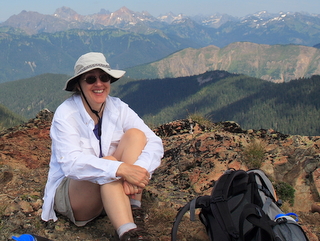 Dork hat = sunburn avoidance. A fair trade, at least on most days.
Extra steps to take in sunburn avoidance
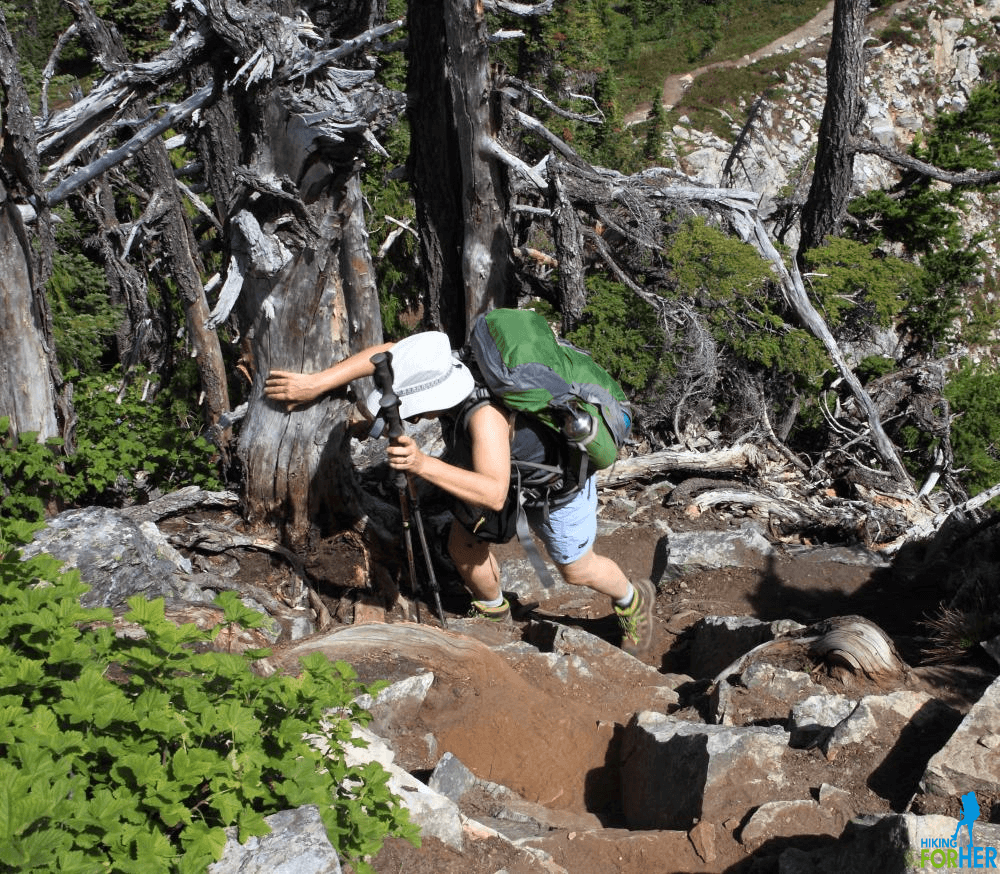
Add a hat which shields your neck, ears, and face, and you're all set.
- Here's a suggestion: get a "dork" hat, like I have! Not very glamorous, but effective.
And don't forget about your eyes. You'll need a high quality pair of sunglasses.
Your eyes, especially if they're lightly pigmented blue or green, shouldn't be exposed to direct sunlight day after day, hike after hike, because of the risk of cataracts.
Strategy #2 to avoid sunburn damage:
Change your behavior
Next, sun avoidance behaviors (or behaviours, depending upon where you live).
This gets tricky.
- You want to be out on the trail during daylight hours.
- You want to soak up as much sun and scenery as you can during those precious trail hours.
So how can you avoid the worst part of the day for UV exposure (10 A til 2PM)?
Simple fact: You can't while you're hiking.
But you can do these things to minimize your skin exposure to direct UV rays:
- Get to the trail head early, around dawn or shortly after.
- Wear appropriate clothing (see above).
- Apply sunscreen (see below) at least 20 minutes before you'll need it.
- Arrive at your turn-around spot (be it a waterfall, lake, summit, viewpoint, camp spot, cabin, river, whatever destination you have in mind) before the sun is directly overhead.
- Seek shade from 10A - 2PM, when the sun's rays are most fierce.
- Don more sun blocking clothing and a hat, and reapply sunscreen if your trail takes you onto exposed locations.
- Plan your hikes for extremely sunny days by pulling out your maps and looking for forest cover that you can retreat to as necessary.
- Drink lots of hiking water to help your body regulate heat and begin to replenish any sunburned cells.
- Build up your sun exposure gradually, allowing the melanin pigment in your skin cells to accumulate over a long time period. Short daily walks without sunscreen, or limited periods of yard work, will help you with this strategy.
Strategy #3:
Use safe sunscreens
Sunscreen is such a blessing. It makes sunburn avoidance so easy!
You can:
- carry it along to reapply when you stop for a break,
- choose the best sunscreen for hiking from a huge variety of brands,
- purchase sunscreen
specifically made for your face, like this SuperGoop.
But here's one thing you absolutely must do: screen your sunscreen!
Don't assume that what you are smearing onto your skin is safe.
After all,
ingredients can be absorbed directly into the lower layers of your skin. That's where your blood vessels are, providing a direct route into your body's circulatory system.
So use only the best sunscreens (use my links above for some hints).
Then it becomes important to do your own due diligence with a patch test:
- Put some of the sunscreen on a patch of skin where you won't mind if a rash occurs;
- Wait 24 hours before using it on the rest of your body.
Cover up even when the sun
goes undercover
Don't spare the sunscreen and long sleeves on cloudy days, because UV light can damage your skin even when it's overcast.
- Our Sol (sunny star) is really powerful!
It's prudent to cover up your lips, too.
- Read my SunBum sunscreen lip balm review.
Chemical versus physical sunscreen ingredients
Recent research has discovered that chemicals are found in the bloodstream after sunscreen application.
There is some controversy over the effects of the chemicals in sunscreens, particularly in connection with disruption of hormones in the body.
Common chemicals in sunscreen formulations:
- avobenzone
- oxtocrylene
- oxybenzone
- octisalate
- homosalte
- octinoxate
Zinc oxide and titanium dioxide, which are mineral or physical blockers, have been found to be safe to apply to the skin, as they are not absorbed through the skin.
Read all of the details, including the concern over inactive ingredients in sunscreens, here.
Avoid skin cancer with regular skin screening
The best advice for hikers of every age:
Don't take your sun exposed skin for granted.
Skin is not an inert stretchy cover, but a living organ which absorbs what you put on it, is nourished or harmed by what you ingest, and will erupt with rashes, bumps, blisters, or worse when it's not feeling well.
Pay close attention to any changes in your moles or freckles, or the appearance of brand new ones, using the ABCDE mnemonic (memory aid) device:
- Asymmetrical Borders
- Color changes
- Diameter (larger than a pencil eraser)
- Elevation
For peace of mind, go to a dermatologist every year for a "mole check" and skin screening.
S/he can help you figure out if that weird spot on the back of your leg is something to be concerned about, or not.
Not even kidding!
Skin cancer shows up frequently behind the knees of sun exposed female hikers.
- For more information on avoiding skin cancer is available from the Centers for Disease Control (CDC).
Sunburn avoidance strategies conclusion
Alright, I've done my part :)
Now it's up to you to apply these strategies to your sun exposed trail time - and to your skin.
Take the time to put barriers between your skin and UV radiation, either through sunscreens, sun protective clothing for hikers, or both.
And if something looks weird on your skin, have it checked out sooner rather than later!
I want you around for a long, long time on the hiking trail of life :)

Avoid Sunburn On A Hike
|
I get emails all the time about what I wear, eat, carry and love to use on the trail. That's
why I provide affiliate links to you: the best gear that I use myself and have seen used by other hikers is instantly
available for your consideration, and the gear company sends a few
pennies per dollar to this reader-supported hiking website. There is no added cost to you! Everyone ends up a winner: Great gear for you, strong gear companies, and more free hiking tips for everyone. Thanks very much for your support. It's warmly and sincerely appreciated. It also helps send these hiking tips to all your virtual trail buddies around the globe. |
 |
|
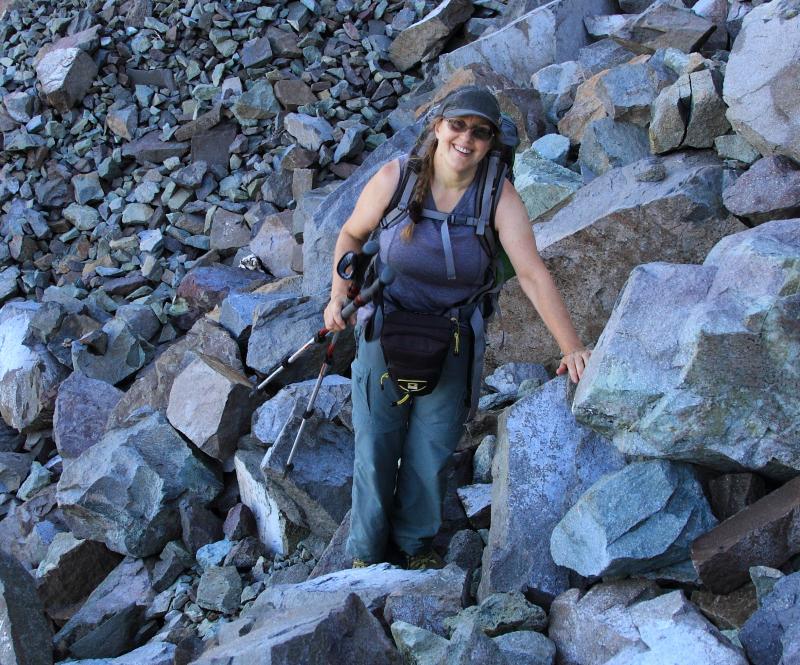
Diane Spicer was a beginner hiker in 1971, and never stopped hiking. She founded the Hiking For Her community in 2008 to encourage female hikers, those who wanted to begin hiking as well as those who were in love with this fantastic sport already. On this website she shares expert hiking tips and recommendations, gear reviews and photos from her outdoor adventures so you can learn the necessary skills for comfort confidence and safety on a hike. This reader supported website does not use sponsored or promoted content. There are no ads, no AI content or artificially generated or touched up photos, no paid link placements. Everything you read is based on decades of personal hiking experience in many different locations. Please enjoy these expert hiking tips as you explore what hiking offers in any weather, season or location. |
 |
Scraping the contents of the Hiking-for-her.com website for the purpose of AI (artificial intelligence) LLM (Large Language Model) training is strictly forbidden.
All rights reserved. No duplication of content without permission.
Photo credits: All photos on this website were taken by David Midkiff or Diane Spicer except where noted.
Disclosures
Privacy Policy
Copyright
Media
Hiking For Her is a participant in the Amazon Services LLC Associates Program, an affiliate advertising program designed to provide a means for us to earn fees by linking to Amazon.com and affiliated sites.