
Enjoy Happy Trails, the free monthly newsletter from Hiking For Her
Receive a free resource: "Hiking Layering System Explained"
Hiking Safety Tips:
Don't Be A Sad Statistic
By Diane Spicer
Personal hiking safety begins before you leave for the trail head.
Trust me on this:
- The best hiking and backpacking safety tips follow a logical plan that begins with rational forethought.
So these best hiking safety tips will help you put together a workable plan tailored to your hiking style.
Let's jump right in with your first basic steps.
If you do nothing else,
at least do this!
These two simple steps will go miles (oooh, hiking pun) toward keeping you out of trouble.
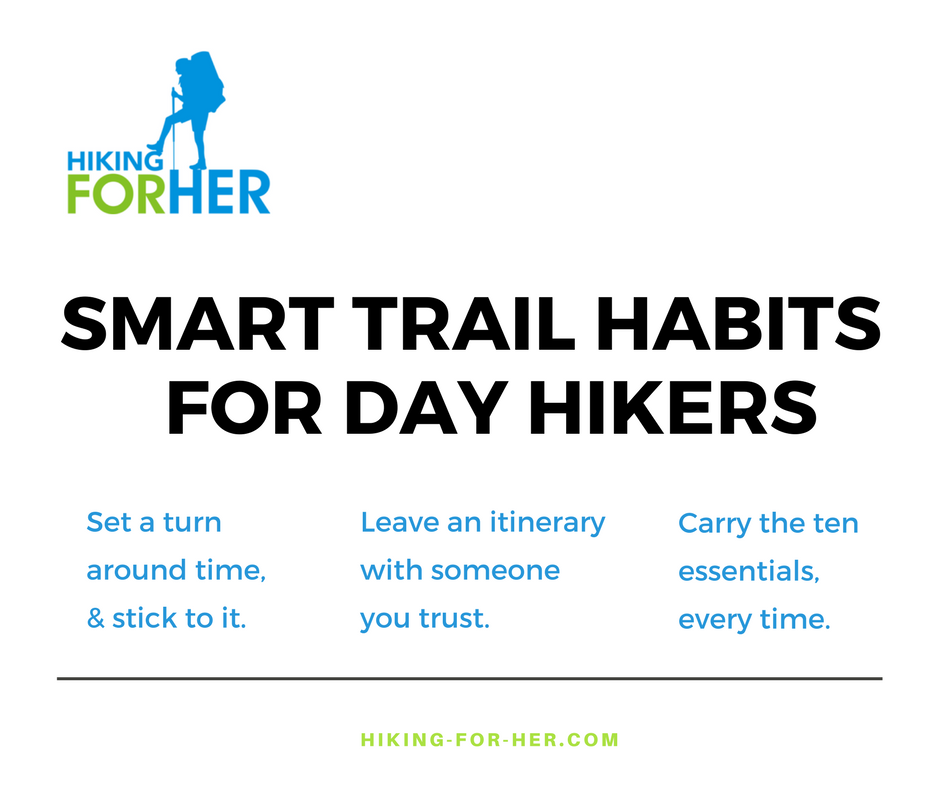
1. Write out an itinerary, and leave it with someone you trust. as well as the agency or authorities in charge of your route.
2. Pour over maps of the area you're planning to hike through and:
- figure out how far you'll hike,
- note where you can get water if you need it,
- understand what the terrain will be like,
- and make a Plan B in case you can't complete the hike.
Every hiker needs to do this
for personal safety
This advice works for both day hikers and backpackers.
But the stakes are higher for a female backpacker, due to the distances away from a trailhead, and the number of days involved in a backpacking trip.
- Know what you're planning to do.
- And then share that plan.
Hiking safety = knowledge
As you can see, hiking safety is all about KNOWLEDGE.
Luckily, you can gain knowledge quite easily on this website and from other sources I recommend.
- Always follow the links, and dig into the wisdom.
Ultimately, hiking safety is your responsibility, even if you always surround yourself with seasoned outdoors people.
Ask yourself...
What would you do if YOU were the only one capable of making decisions on a backpacking trip?
For example: hypothermia strikes your hiking partner, and it's up to you to navigate out to the trail head... and you don't know how to read the map.
Or know exactly where you are.
- Food for thought, no?
Mental issues such as the brain fog of hypothermia may keep your hiking partner -or you- from making good decisions in the moment.
And nothing is more anxiety provoking than getting lost while hiking.
- One bad decision can lead to another, as is often the case when rescued hikers are interviewed after the ordeal.
What about physical safety issues
on the trail?
There are a myriad of physical problems which can flood your system with fear and impair your hiking safety in the great outdoors without impairing your judgment.
Let's take a look.
For bonus safety points as we go along, ask yourself:
"How can I control or minimize this problem for myself?"
Hiking safety:
physical problems any hiker can face
Handling trail stressors as they arise is an important skill to develop.
It's called trail mastery, and comes with experience and logging lots of trail time not only as a day hiker, but as a seasoned backpacker.
Consider these hiking safety tips on specific physical problems or issues that you might need to avoid or handle appropriately:
- illness
- hiking injuries
- getting lost
- hiking with glasses
- sunburn
- lightning
- hypothermia
- altitude sickness
- dehydration
- contaminated drinking water
- hot weather hiking issues
- food borne illness in hot weather
- cold weather challenges
- winter hiking
- hiking during wildfire season
- staying safe during hunting season
- avoiding falls
- survival situation
- falling tree risks
- tick bites
- snake bites
- muscle sprains or strains
- navigational mix-ups or mistakes
But don't stress when you see that long list of safety concerns for hikers!
Instead, get prepared by reading up on these outdoor hazards and know what to do before anything bad happens.
Self-defense
Unfortunately, safety for women hikers may also mean self-defense.
A female hiker in the wild can become a female hiker attacked.
Let's look at a few scenarios a backpacker or day hiker might face on the trail.
Wildlife
Certain reptiles and mammals can mean trouble if you happen to mis-read their body language.
How would you react to a black or brown bear charge?
- Know when and how to use bear spray.
- And always store your food in a way to discourage snoopy bears (or hungry rodents).
As an aside, here's my favorite bear-related quote:
"My advice for grizzlies is to try to maintain sphincter control."
-Kerry Snow, volunteer trail manager with the Potomac Appalachian Trail Club, 1990
What about safety for women hikers traveling through rattlesnake country?
Or if you spot a cougar?
In my humble opinion, count yourself lucky!
I have yet to see a rattlesnake or an entire cougar - only one tiny glimpse of a cougar backside disappearing into the brush.
- These critters are elusive.
- Snakes would much prefer to avoid you, and rattlers give you plenty of warning.
- Only solo hikers should be truly concerned about going up against a big cat.
If you're hiking through mountain goat terrain (sub-alpine or higher), use these safety tips for greater awareness of your options when confronted with a curious goat.
- They are animals I encounter regularly on my hikes.
Human predators
Also of concern: other humans.
Any woman hiking solo has probably had a conversation in her head about "vibes" when meeting a solo male hiker.
I know some guys find this offensive ("Hey, why am I immediately suspect?"), but it's a cold, hard reality:
Female solo hikers have been assaulted and killed by males.
- Not so much the other way around.
If you hike near busy urban areas, you might want to consider how to keep yourself safe at trail heads or popular camp grounds.
And get really good at sizing up people in a hurry.
- This book can help.
As a female hiker, you have serious personal choices to make about safety regardless of whether you're on the trail for a day or a multi day backpacking trip:
- self defense techniques & training
- carrying pepper spray
- hiking with a large dog trained to attack on command
- carrying a weapon
All of these choices carry a large amount of responsibility, to yourself and to others.
No one can choose for you, so take time to think through the consequences for yourself.
Don't become a statistic
So what do you need to know to keep yourself from becoming a hiking statistic in a police report?
At the very least, you need to stay aware of your surroundings.
Awareness when hiking
with trail buddies
Women who hike in groups or with a trail buddy tend to get chatty - nothing wrong with that, but someone needs to keep track of important things:
- the time of day,
- the arrival of an agreed upon turn around time (on day hikes),
- anyone who appears threatening.
If you're backpacking, someone should be looking for landmarks and topographical clues that you're getting close to your campsite for the night.
Solo hiking and mindfulness
When you're hiking solo, you're in charge of your own hiking safety:
- pacing yourself properly and remaining aware of how many hours of daylight are left in relation to how many miles of trail are in front of you,
- accepting the reality of risks you may face,
- knowing your gear inside and out, and
- deciding how to deal with strangers on the trail.
In essence, you're making continuous decisions which impact your hiking safety, top to bottom, day and night.
That's part of the allure of hiking solo!
But if the thought of being in charge 24/7 overwhelms you, you're not quite ready for a solo backpacking hike or trip.
No worries, just learn more trail skills to build up your confidence!
Tip:
Every hiker, solo or not, should carry the ten essentials and a hiking survival kit, each and every time, especially when travelling solo.
Safety habits & training
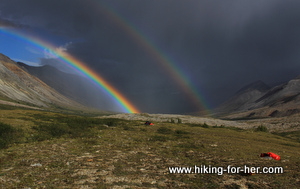
Every hiker should keep an eye on the sky (and not just because double rainbows happen, as in the above photo).
Cloud patterns and wind direction are billboards, telling you what the weather is doing.
- This is especially important in the mountains, where bad weather can whip up in a matter of minutes and make you cold and miserable.
- Read these high altitude hiking tips.
I highly recommend basic hiking safety and first aid training, some rudimentary plant & animal identification training, and deep familiarity with your gear.
Also make time to practice safe water crossing techniques in shallow, easy streams.
Or you could wing it in the face of adversity! Your choice (she said with a frown :(
The double edged sword of
technology for hikers
Maybe you're wondering why I haven't mentioned technology yet.
Two reasons:
First, I'm a stubborn, old school hiker who would rather rely upon tried and true methods and knowledge, rather than a battery powered gizmo.
- OK, I'm not that bad (or quite that old yet!).
I do acknowledge that GPS can get you off a mountain in a swirling fog - if you can get a signal (Please, weather gods, align the satellites!).
And a Personal Locator Beacon just makes good sense when you're way out in the backcountry and may need to be rescued.
- For enhanced features such as two way communication, trackability, and rescue messaging, a Satellite Messenger is what you need.
Reason number two?
Technology can convey a false sense of hope, or provide dangerous distractions, for some hikers. It's not a fool proof guarantee of hiking safety.
Hiking during hunting season
Are you aware of when firearm and archery hunting seasons occur in your preferred hiking areas?
Can you plan a safe backpacking trip by avoiding designated hunting areas?
Do you know the top three things to do to avoid being mistaken for a game animal?
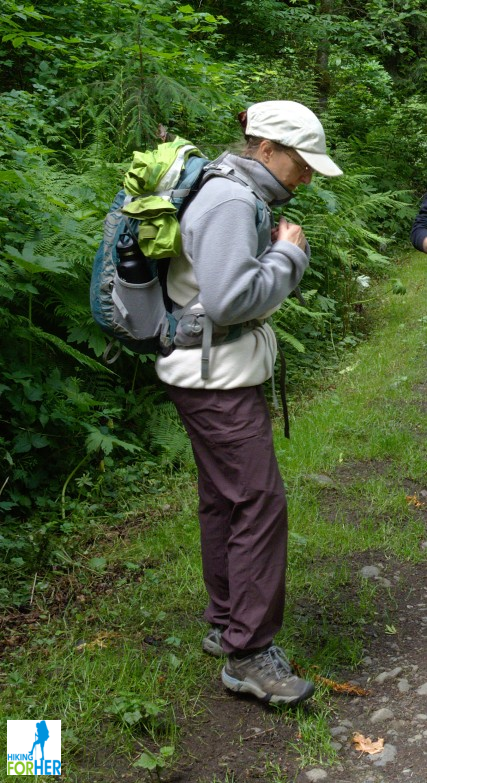
Helpful hiker personal safety habits
I have an ingrained habit to review my "short list" of safety skills at the beginning of winter and summer hiking seasons, including a quick session of looking at photos of cloud patterns and reviewing the living things that can make me itch or die.
Seriously!
More good hiking habits for safe trails you might want to adopt or adapt:
- I rummage through my pack and swap out seasonal hiking clothing.
- I replace any expired items in my first aid kit.
- I throw away the fossilized turkey jerky at the bottom of my emergency bag & restock my stash of hard candy & SPF 15 lip balm.
- I pay particular attention to hiking safety items: headlamp, fire starter, rain gear, and signaling devices.
- I do a battery check on whatever needs it: headlamps, GPS, etc.
Also review your
knowledge base
As I am doing these things, I remind myself to mentally review knowledge that will keep me safe on the trail.
Sometimes that sends me over to the bookshelf to look up how to treat sunstroke, or how to avoid avalanche danger.
And it keeps me confident in my knowledge base, should an emergency arise on the trail.
In addition to regular first aid supplies, carry some items to deal with run-of-the-mill hiking problems:
- insect bites: AfterBite
- sore muscles: Mineral Ice
- skin chafing: BodyGlide
- woodtick removal: Tick Key
A survival kit might make sense for your hiking plans, too.
And don't forget to carry a female hiking hygiene kit you can put together using these tips.
Fun freebie for you
Would you like to know what my "alternative" first aid kit has in it?(free pdf download)
It might make a fun addition to your hiking pack list.
Safety for women day hikers and backpackers can be as simple as that!
Home page > Best Hiking Tips >
Hiking Safety For Female Hikers
Diane started hiking in 1971. She started Hiking For Her in 2008 as a resource to encourage every woman to take a hike. Please enjoy these expert hiking tips as you explore what hiking offers in any weather, season or location.
Meet Hiking For Her's Diane
TODAY'S BEST OUTDOOR GEAR DEALS
REI Co-op Members save an extra 25% on REI Outlet fitness clothing & gear 4/12 thru 4/15.
Example: Hydro Flask bottle with cap, marked down from $49.95 to $26.73.
Use code OUTFIT24.
See ALL the great deals on the Hiking For Her Best Current Deals page!
POPULAR POSTS


Diane Spicer founded the Hiking For Her community in 2008 to encourage female hikers, those who wanted to begin hiking as well as those who were in love with this fantastic sport already.
On this website she shares expert hiking tips and recommendations, gear reviews and photos from her outdoor adventures to welcome everyone to learn the necessary skills for comfort and safety on a hike.
This reader supported website does not use sponsored or promoted content. There are no ads or paid link placements. Everything you read is based on decades of personal hiking experience in many different locations.
All rights reserved.
Photo credits: All photos on this website were taken by David Midkiff or Diane Spicer except where noted.
Disclosures
Privacy
Copyright
Media
As an Amazon Associate, Hiking For Her earns from qualifying purchases.
When you buy through our links to trusted outdoor gear affiliates, we may earn a commission while you pay nothing extra.