
Jetboil MicroMo Cooking System Review:
What This Technology Gives A Hiker
By Diane Spicer
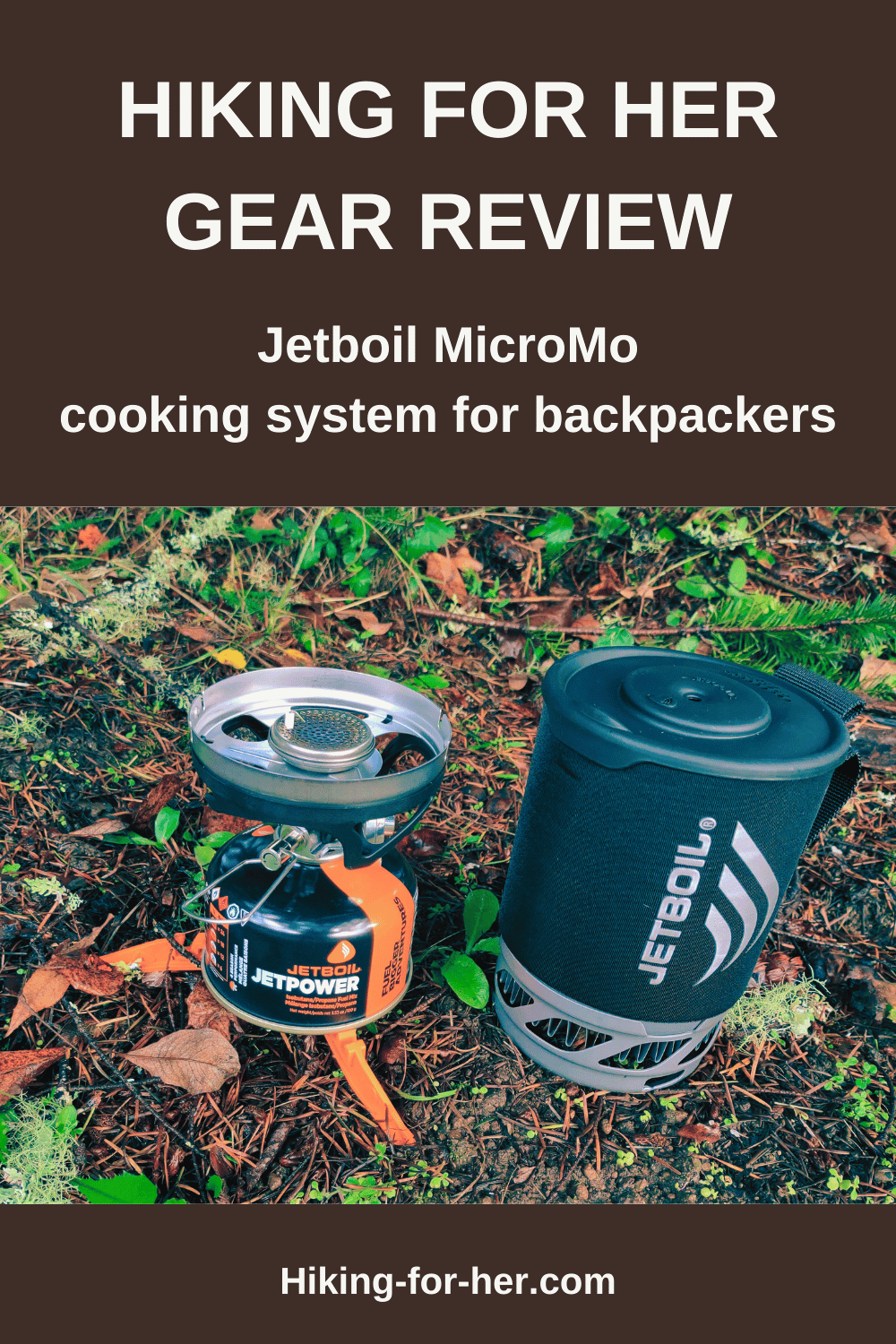
Welcome to this Jetboil MicroMo cooking system review.
Hiking For Her does gear reviews like these because it's important to me to put great hiking gear into your hands, the stuff that really does the job on the trail.
And I'm guessing that you think like I do as a hiker: you want high performance from your technology, and are willing to invest in it.
My main motive in trying new hiking gear and writing gear reviews
The most important thing to me in hiking gear as the years roll by?
Safety.
As in being prepared to safely handle changing weather, variable trail conditions, animal encounters, and unforeseen events.
And that's why I agreed to write this unpaid Jetboil MicroMo cooking system review: being prepared is something we can all agree on as hikers.
Having a fast way to warm up surface water or to melt snow is crucial for keeping your core temperature steady in the face of fluctuating conditions or unforeseen delays.
Of course, there are other reasons beyond safety to carry a lightweight backpacking stove system like this Jetboil, and we'll get to them in this review.
And tips on how to get the most out of this technology.
All shall be revealed, just keep reading!
Skip to the part(s) of this Jetboil MicroMo cooking system review you're most interested in:
Disclosures in this Jetboil MicroMo cooking system review
Hiking For Her received a Jetboil MicroMo in exchange for an unpaid, unbiased review based on testing the system in the field.
The fuel canister, not included with the MicroMo, was purchased with my own money.
All opinions and images bearing the Hiking For Her logo in this review belong to HFH.
There is no affiliate relationship between the Jetboil company and Hiking For Her.
If you purchase any Jetboil products through this Amazon Jetboil link or this REI Co-op Jetboil link, HFH receives a small commission while you pay nothing extra. It's a much appreciated way to support this ad free hiking site.
What's being discussed in this
Jetboil MicroMo cooking system review?
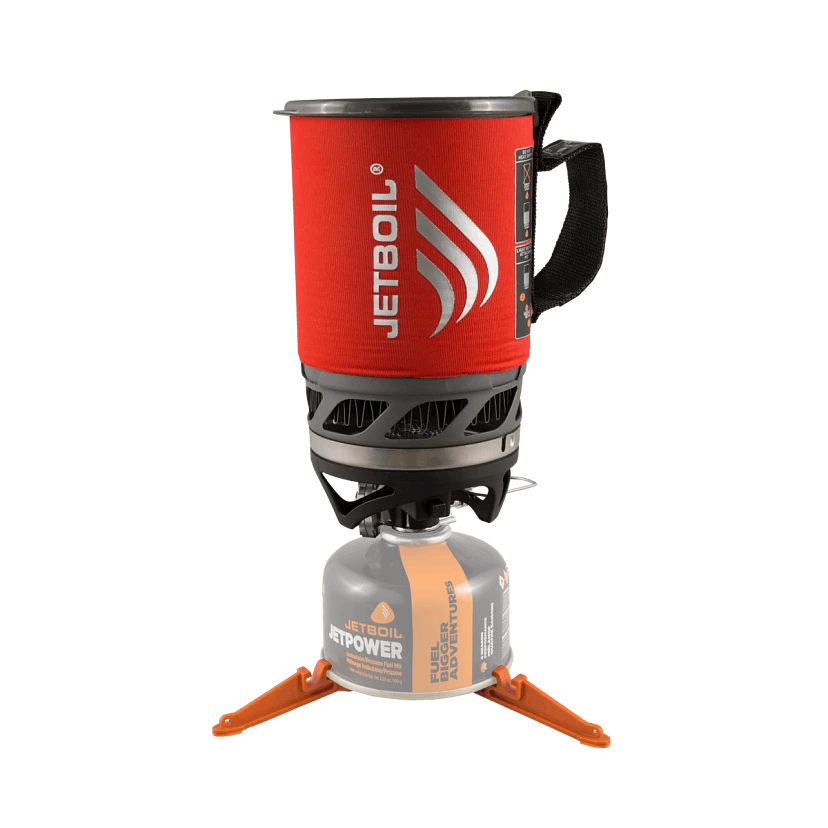 MicroMo image courtesy of Jetboil
The word "Jetboil" is synonymous with heating water up fast and then getting on with your hiking business.
This particular Jetboil is an integrated lightweight cooking system designed for backpackers, for reasons you will soon understand.
There is an entire line of systems for different hiking styles, from hikers kicking back at a campsite after a day hike to dayhikers tackling long hikes or those backcountry group hikers who need a lightweight, reliable way to get hot food into tired bodies day after day.
Jetboil MicroMo cooking system review:
product specifications
The MicroMo's technical specifications, which were not verified by HFH, include:
- 12 oz | 340 g without fuel canister (not included; 7 oz for 100g) or fuel stabilizers attached (plastic, included)
- Gas mixture: butane/propane
- 6000 BTU/h / 1.75 kW power output
- Regulator valve for incremental fuel flow
- Capacity just shy of 1 liter: 0.8L capacity
- 2m 15sec per 0.5 liter (avg. over life of JetPower can)
- 12 liters boiled per 100 g Jetpower canister
- Packed dimensions: 4.1 in x 6.25 in | 10.4 cm x 15.9 cm
- Minimum storage temperature: -40F/-40C
- Minimum usage temperature: 0F/-20C
Once again, without the numbers
Let's summarize all these specs in the words a backpacker loves to hear:
- Lightweight
- Small footprint with nesting parts
- Powerful output
- Fast boil times
- Efficient use of fuel
- Straightforward set up and usage
- Useful in nearly all hiking conditions
- Insulated cozy on cooking cup
- Drink through lid with spout, strainer
- Included: fuel canister support, pot support, triple purpose bottom cup (measuring cup, bowl, stove protector)
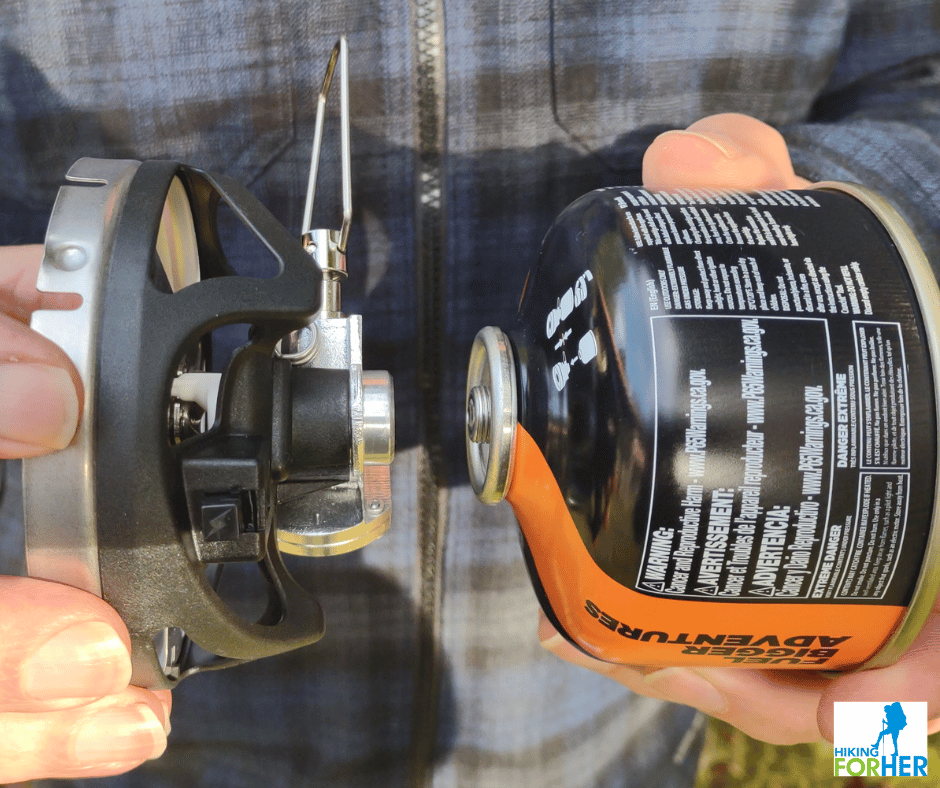 Joining the fuel canister to the burner is achieved with an easy twisting motion
What does the MicroMo offer you as a hiker?
Lots of reasons to purchase this piece of technology, as we just noted.
But look a little deeper at what this cooking system offers you in terms of features you need as a hiker:
- Convenience: fast set up and push button ignition
- Efficiency: half the fuel consumption of other stoves
- Safety: a hot beverage in nasty weather in just a few minutes
- Peace of mind: technology that makes an unexpected night in the woods more manageable, a big consideration when hiking solo, with kids, or those with health conditions; also important gear to reassure those left at home if your return is delayed
- Versatility: one-pot system with a cooking pot support (included) that accepts your own backpacking cooking pots and pans, plus Jetboil add ons to extend cooking options
- Control: regulator valve allows incremental control over the flow of fuel (simmer, saute, slow roll, full boil)
If you're a newbie hiker, here are two real (happened to me) scenarios when carrying this Jetboil makes sense.
Or skip to Performance Notes in this review
Scenario #1
You've planned for a long day hike in high summer, great weather and plenty of daylight to explore a particular loop trail you've had your eye on.
Just about half way through the 12 mile hike, your hiking buddy twists an ankle.
Badly.
Because you didn't get an early start at the trailhead, it's already mid-afternoon.
The weather has decided to build some dark cumulus clouds and there's a bit of a breeze picking up.
In other words, it's gonna rain on your unhappy little parade.
No cell signal, either, and you're not carrying an InReach device.
You have a decision to make:
Stay with the injured person and wait out the weather until you can hike out for some help tomorrow, or leave the person to get help today.
Either way, a Jetboil is going to be useful to hydrate, feed and comfort you and/or your hiking buddy. It's easy to use, meaning even someone in a fair bit of discomfort can operate it safely.
Scenario #2
You love snowshoeing, and you're not afraid to go it alone when no one else has time to accompany you.
One reason for your confidence in solo snowshoeing is that the trails you use are summer trails that have pretty good markings, trail junctions and wooden bridges over streams.
Today you decide to tackle a trail with a fair bit of steep uphill so you can gain a vantage point over the deep valley you started in.
It's hard work because you're breaking trail most of the way, so you're sweating and tired when you finally break out of the trees and enjoy your viewpoint.
In addition, the cold is getting to you (time to pull on more layers) and your hunger level is off the charts. Cold snack bars just aren't going to give you the boost you need to make your way back down the elevation drop of about 1000 feet.
Time to fire up the Jetboil! A hot beverage, maybe some soup or a dehydrated meal, and you'll be ready to make your way safely back to the trailhead before nightfall.
Jetboil MicroMo cooking system review:
performance under trail conditions
Here's where it gets real.
Why carry technology that doesn't perform well or give you the results you desire on a hike?
My experience with this cooking system is subjective and biased by that day's conditions, so take my findings with a bit of skepticism.
You'll run your own tests and come to your own conclusions, but for now, let's go with my data.
Did the Jetboil MicroMo cooking system heat water as fast as promised?
Remember the spec?
2m 15sec to bring 0.5 liter of water to a boil.
The caveat, of course, is that altitude, starting temperature of the water, and weather conditions are going to mess with this result.
I tested the MicroMo in early winter conditions, with soggy ground and morning temperatures in the 40s (Fahrenheit) at around 400 feet altitude.
I started with 500 ml of cold surface water, using the convenient volume marks inside the cooking cup.
According to the timer on my phone, I achieved steam coming out of the cooking pot in 2:38.79 minutes.
Not bad!
[Who am I kidding? That's pretty darn fantastic.]
Was this Jetboil cooking system stable?
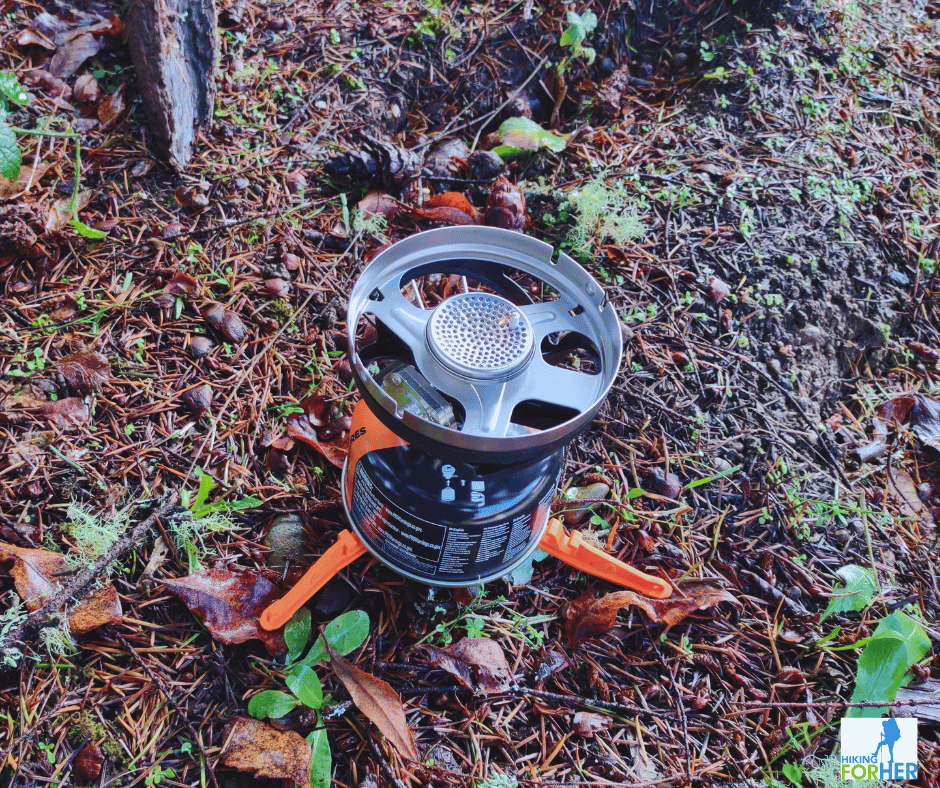
By that, I mean tippy or easy to knock over when placed on the ground.
You want to place your cooking system out of the way of harm your own clumsiness, while still being handy so you can check the progress of what you're heating up.
Recall that plastic fuel canister stabilizers (the little orange feet, all one unit which fold outward to form a tripod) are included with the MicroMo.
This is much better option than propping up the stove with rocks or digging out a resting spot in the duff, wouldn't you agree?
I purposely chose a patch of semi-bumpy ground to test the system, knowing it would perform even better on a flat surface such as a picnic table at a campground.
That canister stabilizer unit really comes in handy!
Did the push button ignition work reliably?
Here I have to admit a bias deeply embedded after numerous "fails" on backpacking trips: fear of flimsy or over designed technology.
In other words, do we really need push button ignition?
And if it fails, can we use this cooking system anyway?
Excellent questions, my virtual hiking friend.
The ignition button is small, and only needed a moderate amount of pressure to create the spark needed to ignite the fuel. It worked every time it was tried (about 10 total for the purposes of this review).
Is it necessary to have this fast ignition? If time were of the essence, like your trail buddy showing signs of hypothermia (see hypothermia tips), it might!
But for most hiking, I'd put it in the "luxury" category of features: nice to have, but not 100% necessary.
What would happen if the magic little button failed?
Whip out the lighter from your hiking survival kit (you carry one, right?) and light the burner!
Was there a learning curve to using this cooking system?
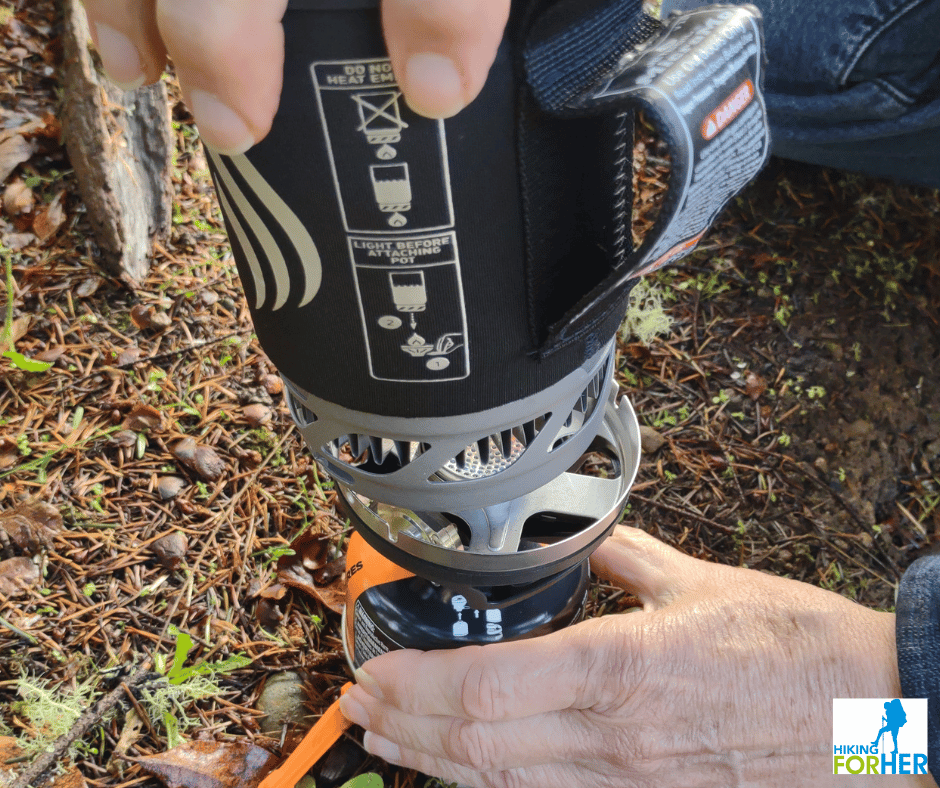
That depends on how familiar you are with backpacking stoves in general, I suppose.
If you're just starting out, Jetboil offers videos and lots of tips on their website as well as included in the packaging.
It's up to you to familiarize yourself with the system before you venture out into the wilds. Know which parts do what, and how to attach, detach and store them.
- And just to be sure, take a photo of the directions to bring along on your first few hikes.
The most important thing to know is that the control valve closes in the clockwise direction, pretty standard for most valves.
If you're comfortable with the idea of fuel canister backpacking stoves, this system is ridiculously easy to get up and running: remove the fuel canister tab (but don't lose it), join the canister to the burner (like docking at the space station, sort of), use the ignition button to get a flame going, adjust the flame so your eyebrows are safe, attach the filled cooking cup and you're ready to wait two minutes for hot water.
Of course, cold hands and poor weather conditions (snow squalls, freezing rain, you know the stuff Mother Nature loves to dish out at meal times) will slow you down regardless of your familiarity with the technology.
- Wouldn't hurt even a hiking pro to practice at least once before your Jetboil trail debut.
What I liked best in this Jetboil MicroMo cooking system review
This cooking system put hot water into my cup fast, no fuss and almost no weight in my backpack.
The insulated cozy on the cooking cup allowed me to have a second cup of hot tea without firing up the stove again.
So if you need one word to sum up what I liked best in this Jetboil MicroMo cooking system review, here it is:
Simplicity
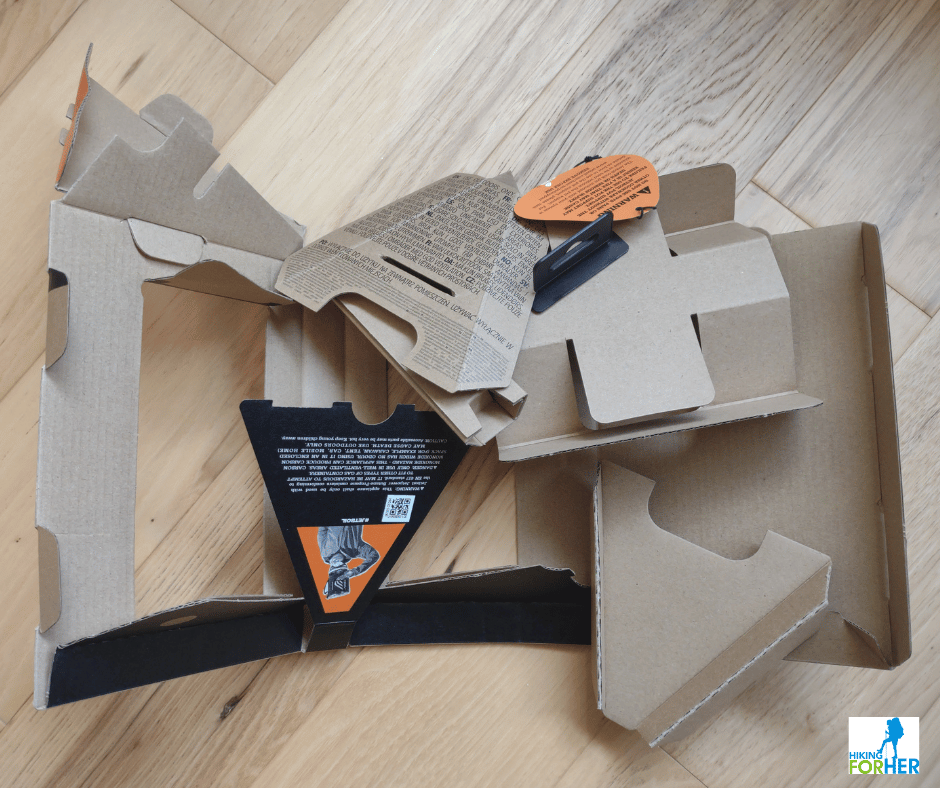
The minimal cardboard packaging, with just one tiny piece of recyclable black plastic, also simplicity itself.
Things to note in this Jetboil MicroMo cooking system review
I wouldn't be doing my job of writing a thorough hiking gear review for you if I didn't point out what can go wrong with this technology.
Or when it should not be relied upon.
There are several things I want to bring to your attention, so let's go through them now.
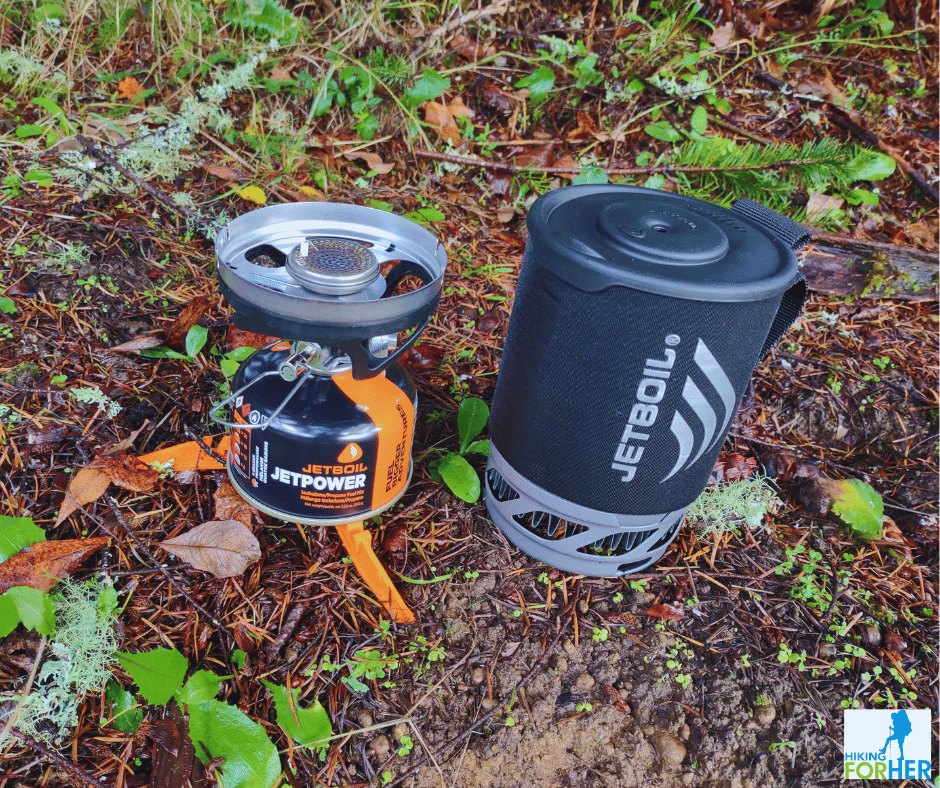 Everything you need to prepare a hot meal in the backcountry from Jetboil
This cooking system is best for certain types of hiking
This cooking system is designed for making small, fast meals or boiling water in a hurry for a hot beverage, first aid, or filling a water bottle for a long cold night in your sleeping bag.
It might also be your backup water treatment plan (a rolling boil in 2 minutes + another minute guarantees you a supply of drinkable water).
In other words, it is a great choice for a backpacking trip, or a minimalist car camping trip.
It's especially useful for solo hikers, those who go fast and light and want to make the most of every hour of daylight (no elaborate meals or extended meal prep).
TIP: Be sure to leave the metal pot support at home to save a bit of weight.
Would a dayhiker carry this cooking system?
- My personal response: I sure will. It's a margin of safety I feel good about providing for myself & trail buddies.
Because it's the smallest cooking system Jetboil offers, this is not what you want if you're planning to cook meals for yourself plus several other hikers every day of an extended trip.
Or maybe it is, if you love lightweight backpacking stove systems and know all the backcountry chef tricks.
- There are compatible accessories to increase the versatility of this system: a coffee press, hanging kit, utensils, a skillet and a cooking pot.
- I'd also recommend a long handled spork to make your meal tasks easier.
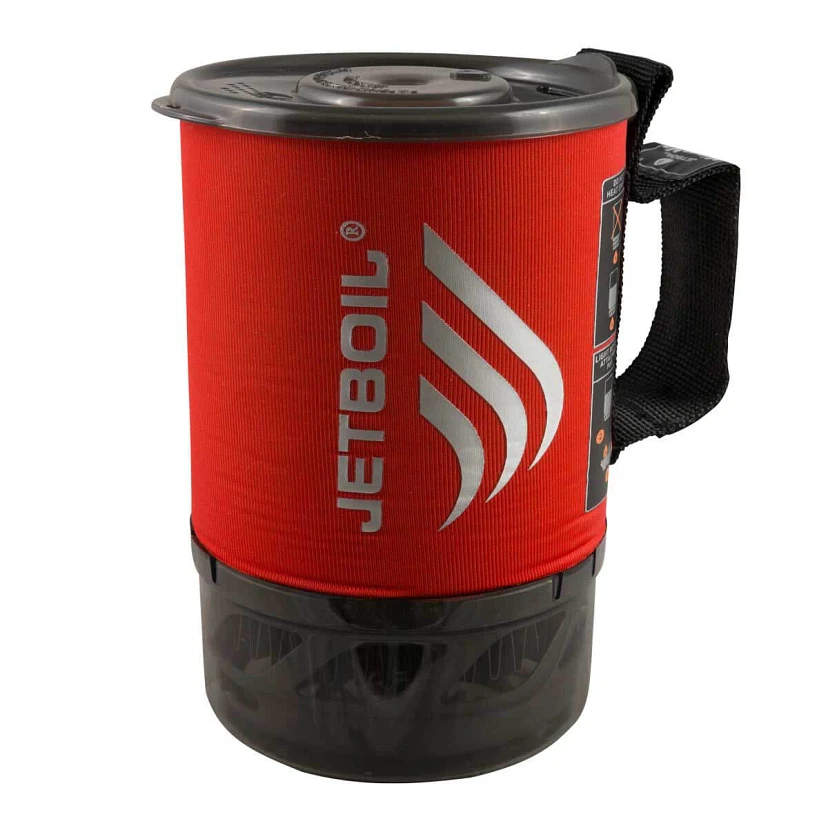 Image courtesy of Jetboil
Don't overload the cooking cup
Yes, the specifications say you can boil 0.8L in one go.
But you shouldn't try to do that. Instead, fill the cup about half way (0.5L).
That prevents a pouring hazard.
It also avoids maxing out the ability of the lid to withstand the torrent of hot water exiting the cup.
Windy condition tips
Back in the day, we carried a beat up corrugated metal strip to shape as a windscreen for our backpacking stoves.
Jetboil recommends NOT using a windscreen to avoid overheating the fuel canister (i.e. setting you up for an explosive event). The design factors in the inevitability of windy conditions, in other words.
But you can help this little cooking system out a bit. Pick a sheltered spot with a natural windbreak when you set it up: downed log pile, boulders, natural depression...
... just not too close to your tent, piles of packs and clothing, or combustible natural materials (dried grasses, heaps of pine needles or leaves, etc.). Play it safe with a distance of at least 4 feet.
A safety note in this Jetboil MicroMo cooking system review:
Keep your wits about you
Be sure to light the stove before you attach the filled cooking pot to the burner. A simple rotation should lock it into place.
Then adjust the flame, fit the pot, and fiddle with the fuel flow control until the Jetboil is pumping out heat in the required amount.
Here's the important part:
Dispensing boiling water from the cooking cup is something you should do mindfully and carefully.
The risk of burning your hand, or someone's hand holding a cup under the stream of water, is real.
The flexible handle on the cup is a compact, lightweight textured fabric loop. That means you'll have to take off bulky gloves in order to get two or three fingers into it to control your pour rate.
This will take a bit of practice. I practiced using cold water, the cup I carry when I hike, and my bulkiest gloves just to get muscle memory working for me. (That's how I know bulky gloves are a no go.)
Important note: The lid does not have a death grip on the cooking unit, so when you're pouring, know that the lid may disengage before you're ready.
Slow, steady pouring is the best approach.
The influence of weather conditions
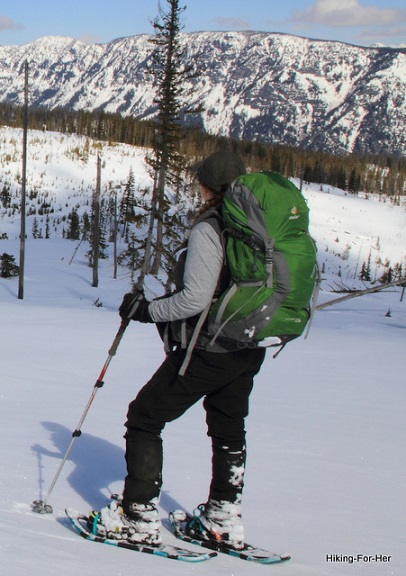 You definitely have room for a Jetboil MicroMo in your backpack when you are snowshoeing
Hiking in cold conditions?
It might take longer to get that stove fired up and the water boiling.
If you're out in temperatures below 20 degrees F (-6 degrees C), the ignition button may not be reliable. Put a lighter into your emergency kit to cover this scenario (mentioned previously).
Fuel canisters can be used in temperatures approaching 0F, but don't push much past that and expect performance.
Durability
That's top of mind for me when I'm using gear directly related to my safety and comfort.
How will this technology perform over the months and years that I bring it along on my hikes?
Obviously I can't answer that in this initial Jetboil MicroMo cooking system review.
But I will update here as needed, and keep an eye on product reviews and redesigns to get a complete picture on the durability angle.
Fuel logs
The worst part of these canister type stoves is the guesswork about how much fuel is left.
Should I bring an extra canister (more weight and cost), or hope for the best (potentially cold meals)?
That's where your trail journal comes in handy.
[This idea will appeal to gearheads who love tables and charts, but repel hikers who are more free spirited. Take or leave the following advice, as your inclinations dictate.]
At the very least, start a fuel log: The canister size, ambient conditions, how many minutes the stove burned, how much liquid was boiled.
Recall the company states that 12 liters can be boiled per 100 g Jetpower canister.
That's a lot of water if you're a solo hiker, unless you're out hiking in hot weather.
On the other hand, in a small group of hikers who enjoy hot breakfast and dinner each day, plus hot beverages mid-day and after dinner, it's easy to go through a fuel canister fast.
If you're a dayhiker who randomly boils up a cup of tea throughout the hiking season, a canister might last a long time!
Keeping a log beats guesswork any day in my book (small joke, sorry).
And here's a cheat:
Jetboil created a fuel gauge so you can check the fuel level of any Jetboil canister (100-gram, 230-gram, and 450-gram) before your hike. It's inexpensive and might save a lot of headaches down the trail.
You can also use it to "gauge" what your fuel consumption patterns are (another plug for your stove log book), making planning for next time that much easier.
Because it's compatible with all isobutane/propane backpacking fuel canisters, this little fuel gauge might be a great stocking stuffer or little gift to yourself!
You already know this but I'm gonna say it anyway:
Test the system first!
If you're planning a long backpacking trip and want to make sure you have enough fuel, but not extra weight, why not do a test of the cooking system at home?
You can use a "weigh the canister before and after" method.
Or you can use a "how many boils can I get out of one canister" approach while you simultaneously test your dehydrated and freeze dried meals.
The issue here is that your cooking technique is different from mine.
You might like a boiling hot beverage after a hot dinner, and I skip it so I don't have to visit the trees at midnight.
You gently simmer noodles while you relax, but I dump a cup of boiling water into my food packet and in 2 minutes it's all good.
Or maybe you are planning to boil water as a purification method (to kill surface water viruses) on top of boiling water for meals and cleanup, and I'm bringing a filter instead.
See what I mean?
Test this cooking system for the conditions and cooking techniques you'll be using.
Then bring the appropriate number of fuel canisters dialed in to your unique plans.
- An extra one never hurt anything, being relatively lightweight and small (unless you're an ultralight hiker, then you have my heartfelt apology for this suggestion).
A safety reminder
It's tempting to use this cooking system inside your tent in foul weather.
Just say no to yourself in a stern voice.
The fuel combustion produces carbon monoxide, a colorless odorless gas that can build up quickly in a confined space.
Also, an open flame, hot metal and boiling water in your home away from home? Don't do it!
Price point, an important piece of information in this
Jetboil MicroMo cooking system review
Talk to a dozen hikers, get at least a dozen opinions on which is the "best" backpacking stove.
So I'm just one voice among the hiking hordes, giving you my opinion of the value inherent in this stove for the price point.
Here's how it goes for me.
There are only a few things that REALLY matter to me on a backpacking trip.
You've already seen my focus on safety.
The other thing that's important to me is a hot meal, or at least a hot beverage, when I'm cranky and tired.
So I'm willing to invest in technology to get that hot bowl or cup of goodness into my hands, fast.
This Jetboil is around $170 US at the time of writing this review, but we all know how prices swing wildly so take that number as a ballpark estimate.
The system requires fuel canister(s), and if you buy the Jetboil brand like I did, that will run around $6 per canister.
- Hiking For Her did not test compatibility of other brands of fuel canisters, but Jetboil provides a list on their website.
Is that price too expensive?
I'll let you decide the answer for your own hiking style and budget.
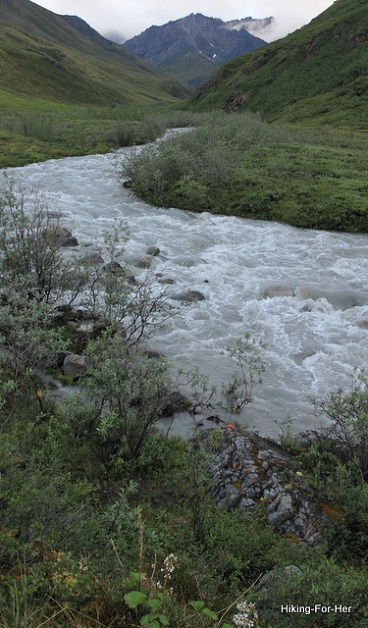 Why spend more time than you have to waiting for water to boil on a backpacking trip?
Final thoughts in this Jetboil MicroMo cooking system review
This Jetboil technology is straightforward to use, the cooking system is stable when assembled, the fuel canisters are readily available, inexpensive and lightweight, and it didn't take up a lot of space or weight in my backpack.
Here's the bottom line for me:
I know that I can put this system together quickly, regardless of weather conditions and in less than ideal terrain (rocky alpine slopes, drenched dripping forest canopy, howling wind, you name it) and have hot food or beverages in my body within 10 minutes.
That might not sound like much if you've reading this just after lunch and are sipping a hot cup of coffee, but in the backcountry, it's everything.
Playing it safe, every time
Maybe you've guessed that technology plays a big role in my survival kit.
I rely on well designed, foolproof and lightweight gear to give me a margin of safety.
This Jetboil backpacking MicroMo cooking system will be used for upcoming snowshoeing adventures (I can feel that steaming mug of tea in my hands already).
On dayhikes, it will travel in my backpack year round along with a few packets of freeze dried food & fuel to give me peace of mind (and a hot cup of salty noodles when I need motivation).
Based on my testing, it has also earned a place on my backpacking gear list, no question.
And here's one more scenario where a MicroMo would pull its weight: if a disaster occurs at home. This little system will provide hot beverages and reconstituted food until power is restored, help arrives, or I run out of fuel canisters.
I didn't mention it before, but I've seen all the various versions of other Jetboil technology on my previous backcountry trips, and they provided rock solid performance in some downright inhospitable conditions.
So let me leave you with this final thought.
- Jetboil has been around a long time. The company bases their designs on what a hiker is looking for in a cooking system. They test their products, and stand behind them.
That means I have no hesitation recommending Jetboil MicroMo to you, wherever and whenever you hike.
Thanks for reading my Jetboil MicroMo cooking system review!

Home page > Best Hiking Gear Reviews >
Jetboil MicroMo Cooking System Review
|
I get emails all the time about what I wear, eat, carry and love to use on the trail. That's
why I provide affiliate links to you: the best gear that I use myself and have seen used by other hikers is instantly
available for your consideration, and the gear company sends a few
pennies per dollar to this reader-supported hiking website. There is no added cost to you! Everyone ends up a winner: Great gear for you, strong gear companies, and more free hiking tips for everyone. Thanks very much for your support. It's warmly and sincerely appreciated. It also helps send these hiking tips to all your virtual trail buddies around the globe. |
 |
|
Diane Spicer was a beginner hiker in 1971, and never stopped hiking. She founded the Hiking For Her community in 2008 to encourage female hikers, those who wanted to begin hiking as well as those who were in love with this fantastic sport already. On this website she shares expert hiking tips and recommendations, gear reviews and photos from her outdoor adventures so you can learn the necessary skills for comfort confidence and safety on a hike. This reader supported website does not use sponsored or promoted content. There are no ads, no AI content or artificially generated or touched up photos, no paid link placements. Everything you read is based on decades of personal hiking experience in many different locations. Please enjoy these expert hiking tips as you explore what hiking offers in any weather, season or location. |
 |
Scraping the contents of the Hiking-for-her.com website for the purpose of AI (artificial intelligence) LLM (Large Language Model) training is strictly forbidden.
All rights reserved. No duplication of content without permission.
Photo credits: All photos on this website were taken by David Midkiff or Diane Spicer except where noted.
Disclosures
Privacy Policy
Copyright
Media
Hiking For Her is a participant in the Amazon Services LLC Associates Program, an affiliate advertising program designed to provide a means for us to earn fees by linking to Amazon.com and affiliated sites.