
Ganesha Ultralight Stove Review
From Hiking For Her
By Diane Spicer
This Ganesha Ultralight stove review offers an answer to a vexing question:
What is the best backpacking stove?
Note that this review offers just one answer among many, because your hiking gear will need to change with your hiking itinerary.
But I think this ultralight wood burning ("twig") stove may provide a solid solution to your cooking needs on a backpacking trip or during international trekking, so keep reading for all the details.
Skip down to what you're looking for:
Disclosures in this Ganesha ultralight stove review
HFH received a stove to test on the trail but has no financial or affiliate relationship with the Ganesha Cookstove Project.
Hiking For Her does not do paid reviews. Nothing you read on this website is sponsored or riddled with paid link placements.
This review was written for one purpose only: to put reliable information into your hands so you can make good decisions about your hiking gear list.
Plus, I was curious about this technology.
Let's give it a good look in this Ganesha ultralight stove review!
What exactly are we looking at in this
Ganesha ultralight stove review?
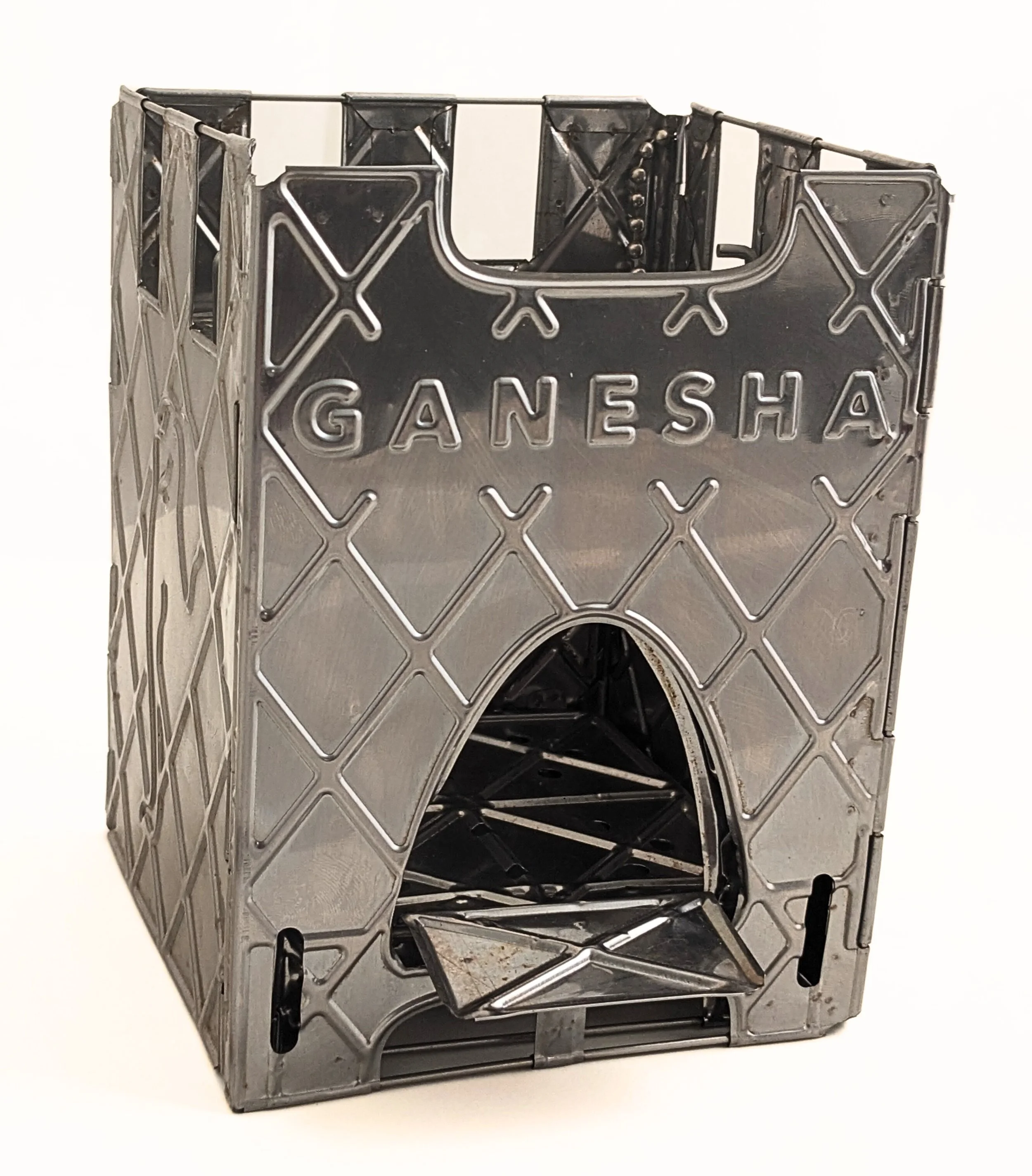 Photo courtesy of Ganesha Cookstove Project
The full name of this ultralight stove is the Ganesha Ultralight Flat-Fold Titanium Smokeless Wood Stove.
That mouthful boils down (small pun, sorry) to this for a backpacker:
- Set up this minimalist feather light stove within seconds.
- Use whatever dry fuel you have at hand to get a flame going fast, adding more fuel to build heat.
- Fill the cooking vessel of your choice with water.
- Expect it to boil in less than 10 minutes.
Sounds good, right?
Now let's dig into how this stove is designed to work, how it actually works, tips on how to maximize its usefulness, and also notes on when not to use it.
Product technical specifications in this
Ganesha ultralight stove review
Weight is our first consideration as hikers, and this titanium stove model will please you with these numbers:
- 7.0 ounces titanium (featured in this review) or 13 oz stainless steel.
That's pretty amazing, considering you don't need to add the weight (and expense) of fuel to your cooking system.
So add 7 ounces together with the weight of your other backpacking kitchen items, and smile at the still small number.
This stove packs down to a flat footprint of 9.9 X 6.9 X 0.5 inches.
Set up time in the hands of an experienced person runs around 10 seconds.
A fire resistant ground cloth made of fiberglass, coated on both sides with silicone, is included to give you a safe perimeter.
Assembled, the dimensions are 5.25 X 5.25 X 6.8 inches.
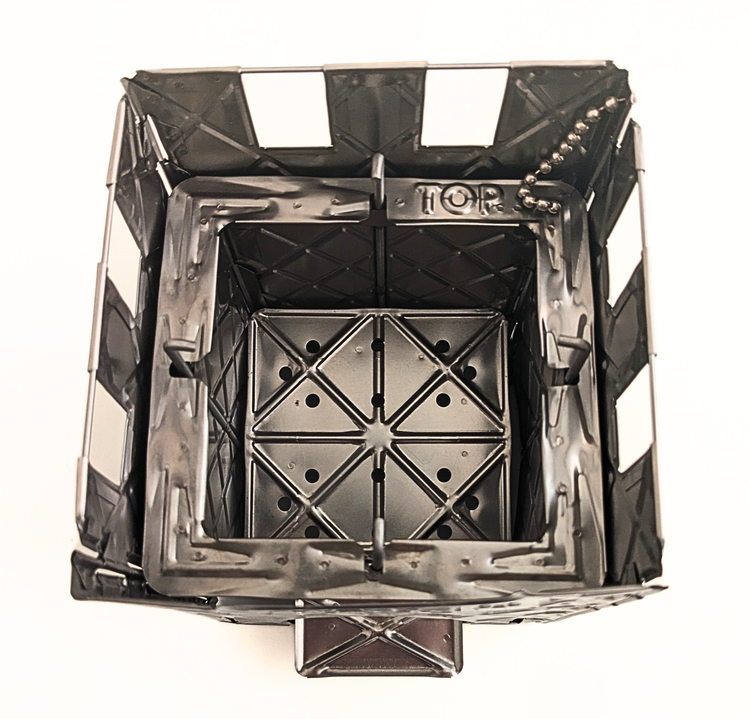 Photo courtesy of Ganesha Cookstove Project
Why would a hiker choose this backpacking stove?
In other words, what features does this stove provide you?
The first thing is the simplicity of the fuel you'll burn.
There is no need to purchase or carry fuel canisters, filled fuel bottles or solid pelleted fuel.
- In other words, no additional cost or bulk to get some hot water in your backpacking mug.
Also, no need to take your best guess at how much fuel is left in those hard-to-recycle canisters.
Any dry biomass can be used for fuel, up to and including dry dung (animal feces).
That's a great feature, but it's also important to know before you go:
- Will there be tree debris or dried grass that you are allowed to collect for personal use?
- Will soggy or wintry conditions leave you scrambling for fuel?
As for animal dung, think of international travel to areas where animals roam freely but fossil fuel may not be so freely available, and this stove might be the right choice.
Another good feature of this ultralight stove: nothing to melt or forget
 A fire resistant ground cloth plus the stove, and you're ready to cook
This stove is pretty low on the technology scale in terms of parts to assemble (3 total), and it's all metal.
The smaller inner stove nests inside the outer stove.
The air diverter is attached to the stove so you can't lose it (you can see the tiny chain in the photo above).
- Tuck it on top of the inner stove, and you're all set.
- You can't even put it in wrong, because the word TOP helps you out.
The set up time is so fast that once you've got your fuel gathered, dinner will be served shortly.
So if you feel intimidated by technology, fear not, this stove is simple in its elegant design and you'll be able to deploy it the first time, every time.
But did it do the job?
"The job" is defined as me holding a piping hot mug of tea in under 15 minutes.
Let's find out.
How did this ultralight stove perform on the trail?
How much wood? What size?
Would grasses burn too hot?
What about thick chunks of bark?
How to start a flame in that small space?
Yeah, I had questions.
Here's how it went for me.
First things first
Once your backpack is off, it's time to gather fuel for the stove.
That might give you pause if you're a backpacker focused on convenience.
After all, it delays dinner time.
And that's why you need to match this stove with the terrain you travel through: readily available dry biomass + this stove = a hot meal.
On the day I tested the twig stove, twigs were abundant on the forest floor (the good news).
But they were soggy from prolonged rainy spells (insert worried frown here).
Unsure of how much wood I needed to get a boiling pot of water for my efforts, I created a mound of downed dead branches from conifer trees, each sporting an abundance of tiny twigs.
The pile was about as high as my knees. (Way too much in retrospect.)
I also stashed larger twigs snapped from those branches, around the diameter of my ring finger and roughly as long as the interior of the stove, within easy reach of my stove set up area.
So who's gonna light my fire? (IYKYK)
Normally I carry a stash of waterproof long matches in my backpack.
But to get the damp twigs to ignite for this stove review, I used the fire-starting kit kindly provided by Ganesha (you can purchase one at the time you purchase your stove).
|
The kit contained two really useful items that I highly recommend, regardless of your backpacking stove choice:
|
 Photo courtesty of Ganesha Cookstove Project Photo courtesty of Ganesha Cookstove Project |
There are a couple of things I want to say about this method of starting a fire.
First, the soaked cotton balls are messy. You don't want to be scratching your nose or adjusting your glasses right after grabbing a bunch unless you like lubrication on your face.
Also, the metal canister they come in is a bit much for me as a backpacker.
- I'd transfer about half of this glob of balls into a tiny zip locked bag, inside another bag.
But me as a car camper? Bring that cute little tin!
Please be careful where you place tendrils of those fuel soaked little beauties in relation to the stove.
Don't hold them in your fingers while your trail buddy uses the ferro rod to create the spark that will make everything just a bit brighter in your world.
Please don't ask.
And don't bury them deeply in the mound of twigs inside the innards of the stove, because they won't ignite.
Basic fire starting 101, right?
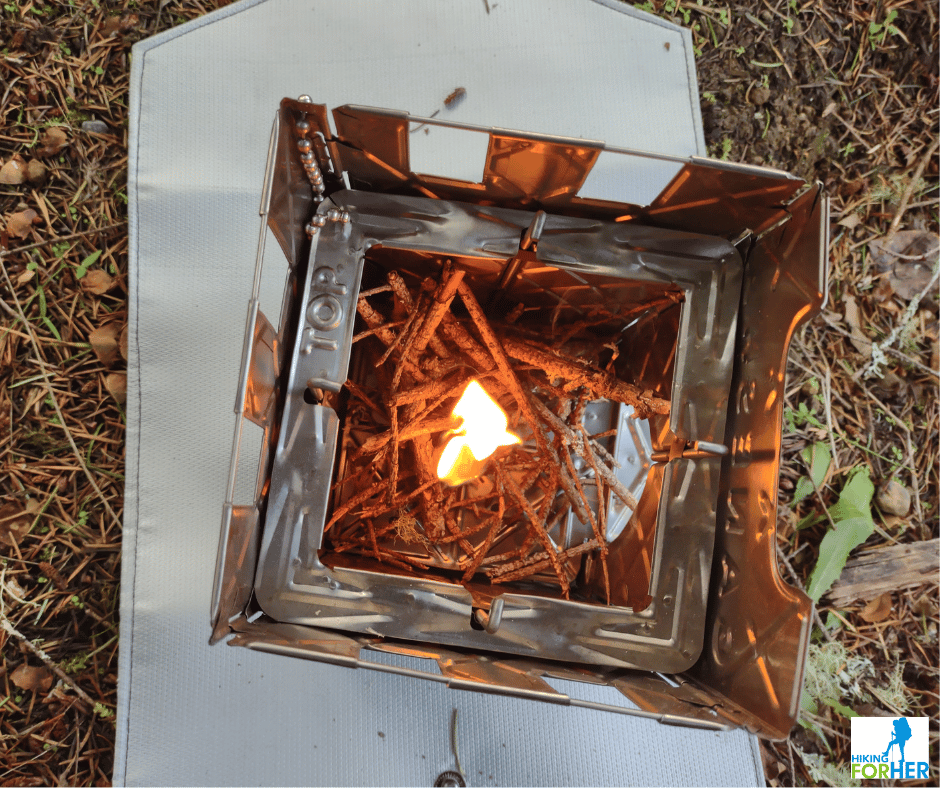 This flame was created within 2 minutes of getting the stove set up on the fire resistant mat.
If you've built a campfire before, you know the drill
Here's where a bit of patience comes into this Ganesha ultralight stove review.
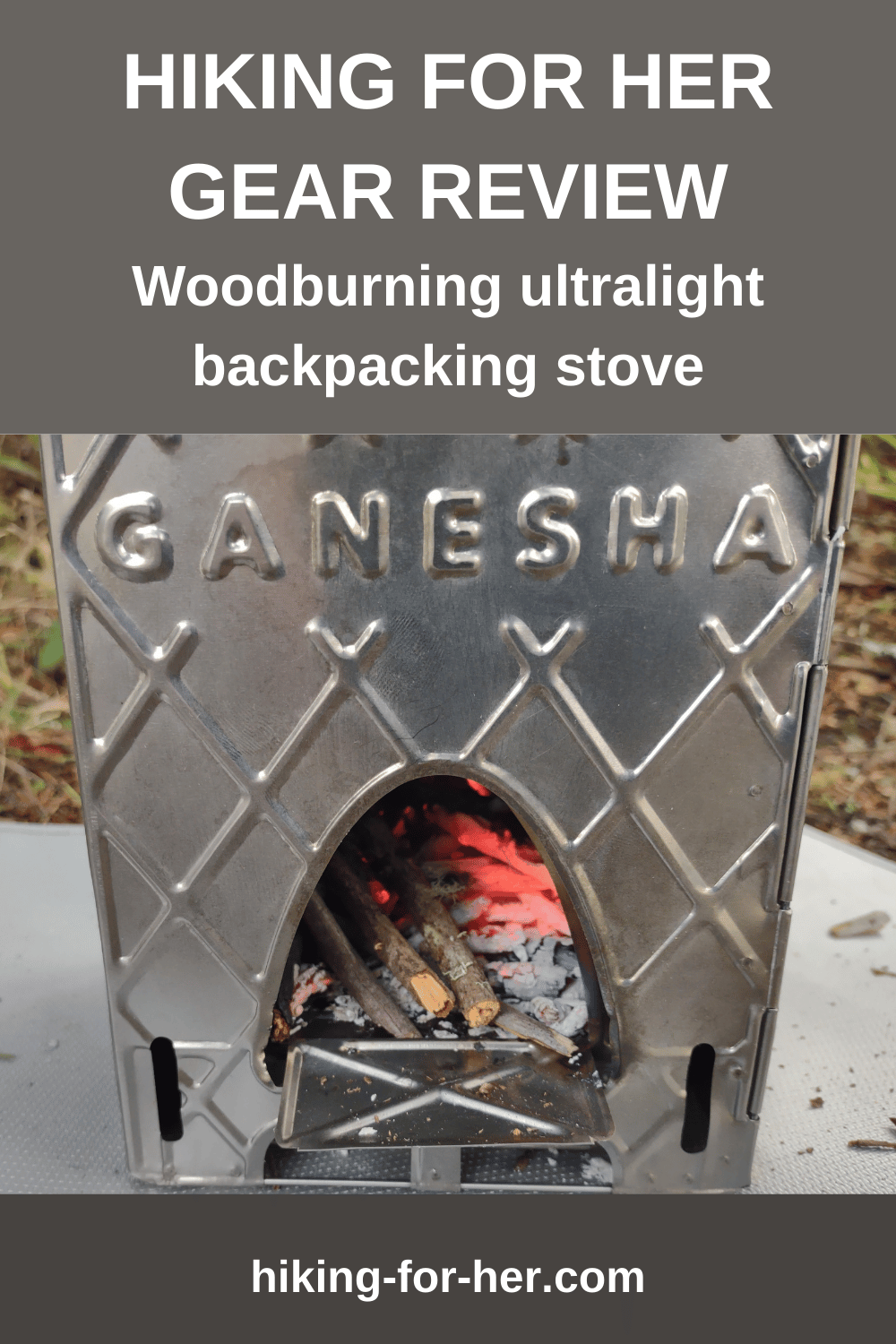
You will need to feed the tiny flame with progressively larger twigs, provide a few puffs of air if there is no handy breeze to help you along, build up a bed of coals and progressively generate the heat you'll need to boil water.
Wait to place your cooking pot on top of the stove, you'll need some flames to be in business.
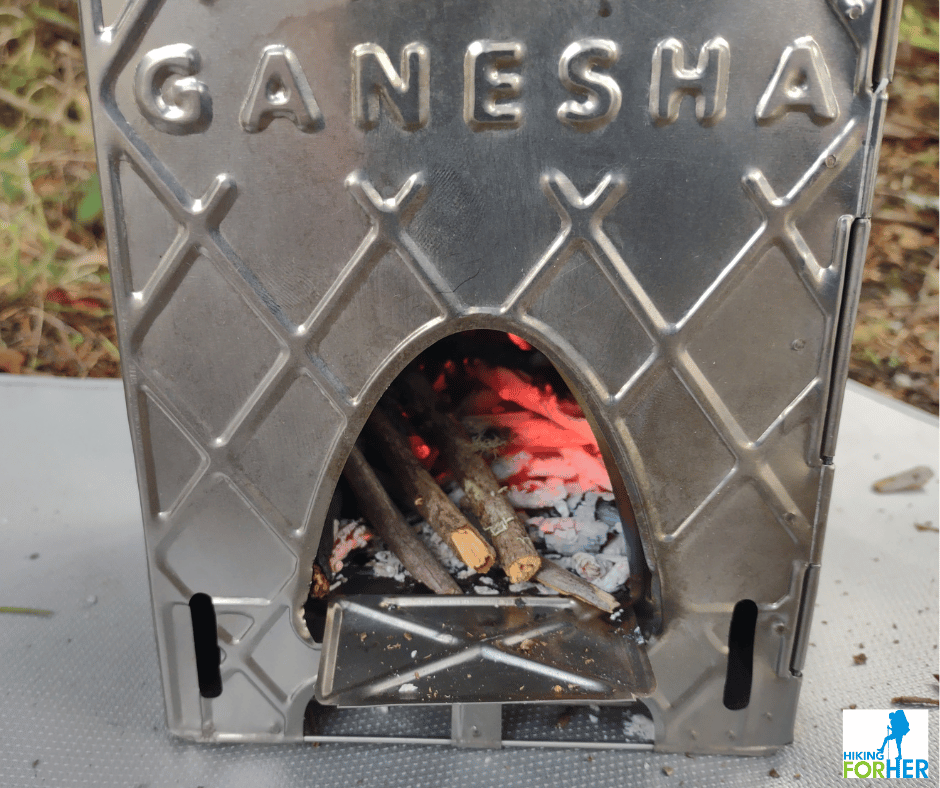
I was quite surprised to see how fast all of that came to pass!
According to the timer on my phone, it took 17:36.53 minutes to achieve boiling water from stove set up to this photo of a rolling boil being taken.
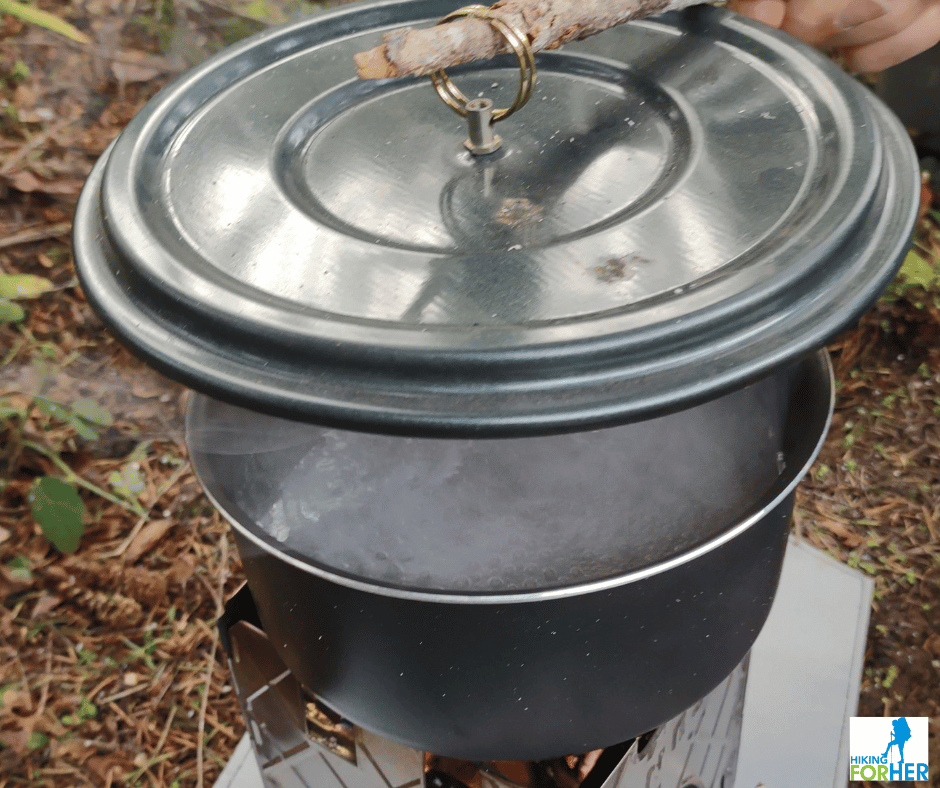
Tiny bubbles accomplished with zero experience using this stove, damp wood, surface water at 45F, elevation 400 feet and no breeze.
I'll take it!
Why is this Ganesha stove so crazy efficient??
I'll let better minds than mine (the design team) answer that question.
"The stove is double-walled to provide gasification - the transport of hot secondary air into the top of the fire, where it burns the smoke.
This creates an efficient, hot, clean fire.
The large front opening is designed to be pointed into any breeze, increasing both primary and secondary airflow."
-Ganesha Cookstove Project website
Ganesha ultralight stove review:
What I liked best about this stove
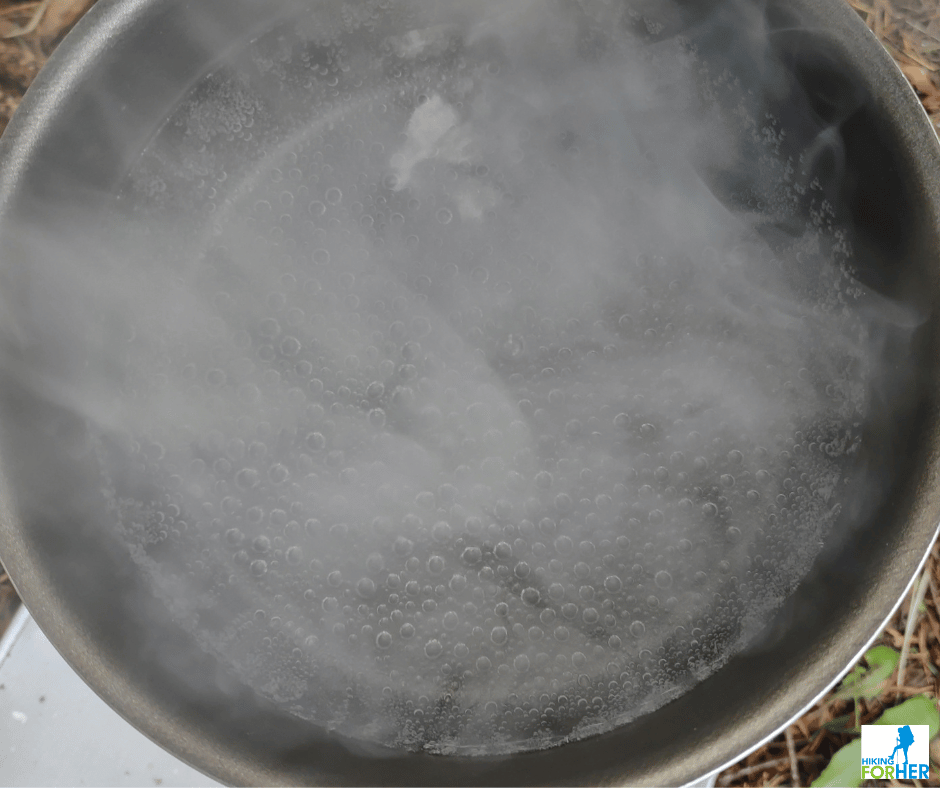 When I see this, I start salivating. Not long until dinner time...
This stove is a versatile little thing!
It accepts all of my cooking pots and my small camp frying pan, so I won't need to buy a specific size to maximize the stove's efficiency.
If I wanted to, I could put an alcohol burner in the base of the stove and use that instead of tree debris. I might have to in certain terrain.
And next time I find dried animal dung (caribou in the Far North, bear scat on the trail, wow! the possibilities are exciting), I'll give that a go.
Gotta mention one more thing, maybe peculiar to me but worthy of your consideration.
If you're backpacking but crave the experience of a campfire, this stove provides a mini version: mesmerizing flames and a chance to use a (tiny) fire stick to poke the glowing coals. Light up this stove to get your fix and return home a contented backpacker.
A few thoughts on durability
Any time a piece of gear has to be folded, unfolded, heated, cooled and then stored again, I worry about durability.
- My latest disaster involved a high end sleeping pad that didn't stand up to being used regularly (twice!! and I was so careful!), so full disclosure, I'm a bit jaded.
But this stove?
It's a sturdy design, with hinges at each corner to make it easy to fold and unfold.
I expect the titanium to stand up to lots of heat cycles.
That said, this stove is ultralight weight and therefore somewhat fragile, given the sparse amount of materials used to build it.
I will handle it carefully when transporting and using it, perhaps 10X more gently than my other backpacking stoves so I don't bend, warp or break it.
But that's just me, notoriously hard on gear and trying to be better.
I cannot tell you at the time of this writing how long the stove will last in my hands (I push my gear hard), but will update this review when needed.
Things to note in this Ganesha Ultralight stove review
Every piece of technology works correctly when you use it ... wait for it... correctly.
That means your expectations about performance, durability, cost and ease of use may influence the outcome of your user experience.
Here, I want to share a few things to set your expectations into a realistic framework.
What this stove is designed to do
This is the little stove that could.
It's simple.
It's designed to ignite biomass quickly.
It boils water fast, as long as you have fuel to feed it.
Ultralight backpackers hiking through wooded terrain, you need this stove!
And if you're hunting for one more way to reduce your fossil fuel consumption, you've just found it.
What you won't get out of this stove
Speed is the first thing that comes to mind.
The folks who make and test these stoves say that boiling water can be yours in 4 - 6 minutes, 700ml at a time.
The stove was designed and tested in Colorado at higher altitudes, with wind being a near constant companion. It performed well for them in 30+mph winds, something that seems incredible to this hiker who would be huddled inside my tent in those conditions.
Here's the secret: The stove is designed to use wind to get a hotter burn. Orient the stove into the wind, and you'll get more for your fuel.
30mph is all well and good, but what conditions are surrounding you as you hover over your stove and watch for bubbles to form on the bottom of the pot perched on the stove?
For my field test, there was zero wind, not even a feeble breeze. I supplied my own breeze, and it didn't really take much to get the fire going.
So results may vary in terms of how quickly your water will come to a boil.
Cold temperatures, scarcity of fuel so longer gathering times, higher altitude, all these will eat into your prep time for a hot meal.
As for lighting the stove, what will you be using? Your choice may impact how fast the fuel "takes".
- Matches can blow out or become saturated in wet conditions.
- Lighters are lightweight and more reliable (to a certain point) in windy conditions, but cold conditions can zap them. So can stepping on them (oops).
The optional Fire Starting Kit I mentioned will help you out when you're not sure which conditions you'll be facing on a backpacking trip.
Recall that it contains a fun little magnesium alloy rod ("ferro rod") that you scrape with a stainless steel striker. Coupled with petroleum jelly soaked anything, you're going to get that stove going in no time.
Not for the backcountry foodie
There is no way to control the amount of heat this stove generates other than piling on/withholding fuel.
So if you love to simmer or saute or perform other culinary shenanigans on your backcountry trip, this won't cut it.
But for me, a food minimalist type of backpacker, no problem. Hand me some boiling water and I'll hand you a luscious hydrated pouch of freeze dried food ;)
No smoke!
You might expect a stove that burns twigs and dried grasses to belch smoke as it consumes the biomass fuel.
Wrong.
This stove is double walled and designed to direct hot air to the top of the fire, where it can consume smoke. It's called a "gasifier" type of stove, as opposed to a single walled stove.
Under my soggy conditions, there was one puff of smoke as the stove came to grips with the damp larger twigs, and then nothing else except the plume of steam when the water came to a boil.
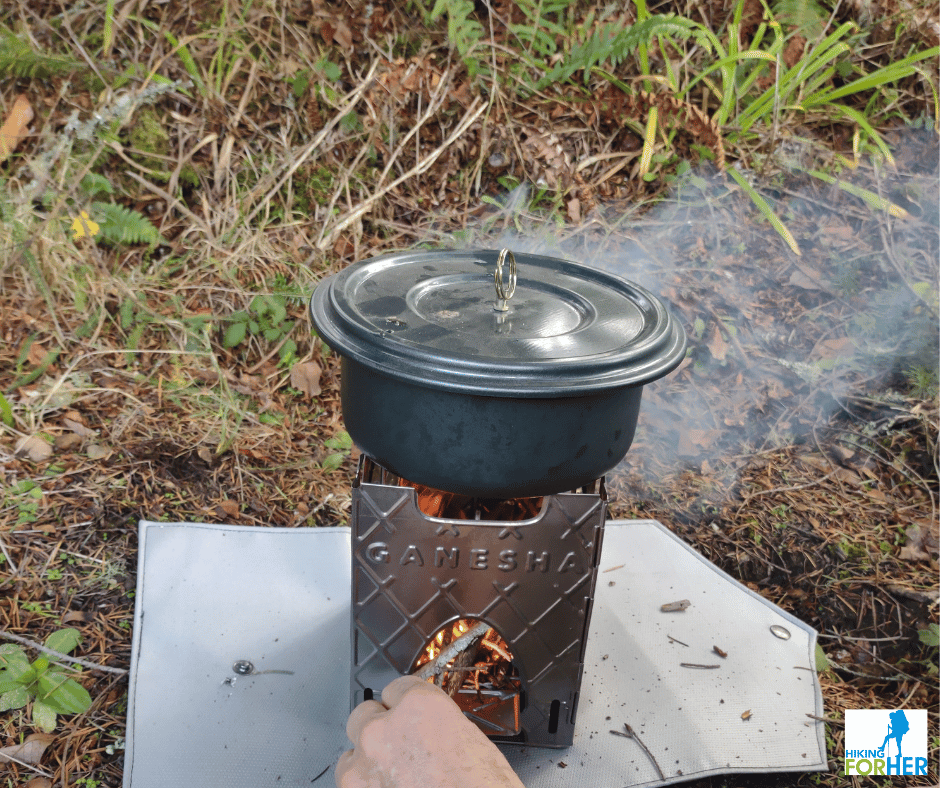
If you're a fan of using wood smoke to drive off pesky biting insects, you'll be hard pressed to achieve your goal with this stove.
Another nice thing about no smoke: It won't give away your location when you're a solo female hiker.
No go zone
This stove cannot be used in areas with active burn bans.
That can get tricky if you start your backpacking trip using this stove as your only means of cooking, and then a burn ban is put into place.
- No open flames is the right policy, but it might leave you in the lurch.
Another wind related note: Should you be using this stove during high winds in areas that are desiccated, in active drought, or prone to burns?
I'll leave that little moral dilemma for you to ponder.
A few additional items you'll need
You'll need a dedicated storage bag to store your flat but dirty stove if you don't want soot on the rest of your backpacking gear.
There is a Tyvek envelope with a velcro closure provided for this purpose, but it would disintegrate in my hands within weeks of soggy backpacking. I'd prefer reusing a plastic bag inside a cloth bag.
- Note to self: Add that to the gear list pronto!
You will need to keep the fire resistant mat handy. It folds up envelope style with a snap closure button, but it should probably have its own little bag.
Your fire starter of choice, plus your primary method of ignition and maybe a back up, could cohabit with the mat.
You'll need to practice with the ferro rod if you've never used one. Getting it to throw a spark is somewhat of an art, and can be unsettling if you try it inside your living room (don't ask).
I'd also recommend a full water bottle standing by your stove, just in case.
This stove is designed to not belch out sparks, but I'm a bit skewed toward the side of safety in light of recent years of wildfires, so I had one handy during the testing for this review.
You will also need to dispose of the ashes to leave no trace when mealtime is over.
- Stirring ashes with water is recommended to be sure nothing smoldering remains after you depart.
- It also dissolves the ashes, leaving... you know.
So that water bottle is going to come in handy twice.
I'm also wondering if solid fuel pellets would work with this stove in high alpine areas or places you can't collect tree debris or animal dung.
Sometimes I pass through lower elevations (plentiful debris) to spend lots of time in rocky areas (do rocks burn?) before descending back to forests, so I'll test this and report back.
Price points in this Ganesha ultralight stove review
There are two choices of stove, and at the time of this writing these are the listed prices:
- Stainless Steel $79.99 US
- Titanium $139.99 US
An optional fire starter kit for cold or windy conditions is $19.95 (described above).
I did notice a sale during the month of December.
When compared with the canister stoves I already own, this stove comes in at a lower price.
Plus, given its simple design, I'm not worried about it failing me. That adds to the value of the stove, in my opinion.
Are there other stoves like this on the market?
Yes, but they are different in design, larger and heavier, and they lack what I'm about to discuss next.
Humanitarian goals motivated its design AND
this Ganesha ultralight stove review
Here's where we get to the heart of the matter.
Literally, the heartfelt goal of the Ganesha Stove Project.
I'll summarize, but to get the entire story behind this ultralight stove you'll need to visit this How It Started web page and meet Brice Hoskin.
An earthquake in Nepal coupled with one man's desire to alleviate suffering in an area with limited resources created the first Ganesha stove design.
Over time, the stove design evolved based on feedback from the village women who used it daily (huge Hiking For Her shout out to women's wisdom).
After a successful Kickstarter campaign, the Ganesha design became available to backpackers like us who appreciate simplicity and weight savings.
As a website devoted to empowering women, HFH deeply resonates with this statement:
"As Ganesha stoves reach the far corners of the world, they can provide many potential benefits, especially for women, girls and at-risk populations."
But this is the quote that really motivates me to spread the word about this amazing piece of technology:
"100% of profits from sales of the Ganesha Ultralight go towards providing humanitarian stoves to villagers in need."
Visit the Ganesha website to purchase a stove, knowing that as you support your backpacking plans you support others in the quest for a quality life.
Final thoughts in this Ganesha Ultralight stove review
I love looking at various solutions to the handful of problems every backpacker faces.
Hunger comes to mind. We all welcome hot food and beverages at the start and end of a long day of hiking.
For me, a bowl of steaming soup and a mug of tea go beyond simple fuel for my body. They help me prepare or recover for the remaining days of the trip.
Mentally as well as physically!
So carrying a backpacking stove is something I do regularly, but I've never tried a "twig" stove before.
As I age, I'm also more concerned about the weight of my gear.
Going ultralight has become a priority for me. Another reason why this stove piqued my interest!
I'm also concerned about human impact on the planet.
When I do remote backcountry trips, the pristine conditions I enjoy are a jarring "wake up" contrast with how destructive we are as a species.
Put all that together, and you have the reasons behind testing the Ganesha stove.
Maybe those reasons resonate with you as well.
I'll leave you with this conclusion in the Ganesha ultralight stove review
I recommend this ultralight stove because it is minimalist but efficient, designed to recycle the carbon in what's already in front of you, leaves no trace, and weighs almost nothing.
In other words, it lowers the impact on my body AND the planet.
And I like that!
If you're looking for a simple, low impact, reliable, affordable ultralight backpacking stove, this is the one to use.
Thanks for reading my Ganesha ultralight stove review.

Home page > Best Hiking Gear Reviews >
Ganesha Ultralight Stove Review
|
I get emails all the time about what I wear, eat, carry and love to use on the trail. That's
why I provide affiliate links to you: the best gear that I use myself and have seen used by other hikers is instantly
available for your consideration, and the gear company sends a few
pennies per dollar to this reader-supported hiking website. There is no added cost to you! Everyone ends up a winner: Great gear for you, strong gear companies, and more free hiking tips for everyone. Thanks very much for your support. It's warmly and sincerely appreciated. It also helps send these hiking tips to all your virtual trail buddies around the globe. |
 |
|
Diane Spicer was a beginner hiker in 1971, and never stopped hiking. She founded the Hiking For Her community in 2008 to encourage female hikers, those who wanted to begin hiking as well as those who were in love with this fantastic sport already. On this website she shares expert hiking tips and recommendations, gear reviews and photos from her outdoor adventures so you can learn the necessary skills for comfort confidence and safety on a hike. This reader supported website does not use sponsored or promoted content. There are no ads, no AI content or artificially generated or touched up photos, no paid link placements. Everything you read is based on decades of personal hiking experience in many different locations. Please enjoy these expert hiking tips as you explore what hiking offers in any weather, season or location. |
 |
Scraping the contents of the Hiking-for-her.com website for the purpose of AI (artificial intelligence) LLM (Large Language Model) training is strictly forbidden.
All rights reserved. No duplication of content without permission.
Photo credits: All photos on this website were taken by David Midkiff or Diane Spicer except where noted.
Disclosures
Privacy Policy
Copyright
Media
Hiking For Her is a participant in the Amazon Services LLC Associates Program, an affiliate advertising program designed to provide a means for us to earn fees by linking to Amazon.com and affiliated sites.